The Chicago-based Tribune Co., the corporate owner of the Los Angeles Times, Chicago Tribune, Baltimore Sun and 23 local TV stations, emerged Monday from bankruptcy after a messy four year process. The Tribune's future is expected to look very different from its newsy past.
Tuesday, 1 January 2013

2012 Round-up: Catching Us With NPR Stories From The Past Year
As 2012 comes to a close, we take a moment to catch up with some of the memorable people we featured on All Things Considered in the past year, including an 85-year-old who remarried the man she divorced 48 years ago, a scientist who put his whole family on Mars time and a man who grows giant cabbages.
Copyright © 2012 National Public Radio. For personal, noncommercial use only. See Terms of Use. For other uses, prior permission required.AUDIE CORNISH, HOST:
We do a lot of interviews throughout the course of a year: politicians, economists, musicians, actors, authors, professors.
ROBERT SIEGEL, HOST:
But we also talk to people across the country who aren't normally newsmakers because they've done something we find noteworthy and we wanted to ask them all about it.
MELISSA BLOCK, HOST:
How big was your world record setting cabbage?
SCOTT ROBB: 138.25 pounds.
BLOCK: 138.25.
CORNISH: That's Scott Robb of Palmer, Alaska, a champion grower of giant vegetables and fruits, talking with our co-host Melissa Block. Robb's held records for the biggest turnips and kale. And this year at the Alaska State Fair, he set the world record for biggest cabbage.
ROBB: The overall size of the cabbage from outside leaf to outside leaf measured seven feet, three inches.
SIEGEL: Wow, that would make a lot of coleslaw. We decided to call Robb to find out what he'll be growing in 2013. Giant cabbage is once more on the agenda, and he's going back to an old favorite.
ROBB: My first world record was the rutabaga back in 1999. I lost it, regained it, lost it, regained it. Now, a gentleman in Wales has it. And he actually did it with seeds that I made available.
SIEGEL: The key to Scott Robb's success with these giant veggies, Alaska's long summer days with lots of sunlight, as much as 19 hours a day, during the month of June.
CORNISH: In Pasadena, California, one family decided to make the most of the long summer days this year. The Ohs - David, Bryn and their three kids - put themselves on Mars time, meaning they had an extra 40 minutes a day, meaning after three weeks, their daily routines had flip-flopped around the clock.
DAVID OH: We were having lunch at midnight yesterday.
(LAUGHTER)
OH: We had lunch at 1 a.m. this morning.
CORNISH: That's David Oh, who needed to be on Mars time to do his job. He's a flight director for the Mars rover.
OH: The biggest reason that we wanted to bring the whole family together on this is because they're joining in the adventure of exploring Mars.
CORNISH: Any adventure of everyday life on a different clock. They went to the beach at midnight. They bowled at 4 a.m., and they had a lot of fun.
SIEGEL: Until school started. The kids went back to Earth time, and Dad stayed on Mars time for two more months.
OH: It was tough. It was definitely tough.
SIEGEL: When we checked in with David Oh, he said toggling between work and family - Mars time and Earth time - left him in a state of continual jet lag. But he thinks being on Mars time as a family was worth it.
OH: We've been a closer together family ever since we did that. We work together better. We actually know each other better. I think we got to appreciate a unique experience together as a family, and the kids enjoyed that.
CORNISH: Finally, we wanted to see how Mrs. Lena Henderson of Buffalo, New York, was doing. She got married in August at the age of 85 to Roland Davis. The man she divorced 48 years ago.
LENA HENDERSON-DAVIS: I never thought that I'd get married again.
SIEGEL: Long story short, they were high school sweethearts, had four children, then divorced after 20 years. Both remarried, he moved to Colorado, and the years went by. They reconnected after one of their sons died. Mr. Davis and his second wife started calling regularly to see how she was doing, and both women became friends. Then last winter, Mr. Davis' second wife died, and his children convinced him to move from Colorado to Buffalo closer to them and their mother. By this spring, Mr. Davis had proposed again to his first wife.
HENDERSON-DAVIS: He said: Would you marry me? I said: What? Would you marry me? I said: Well, hmm. And then I said: Yes, I will.
CORNISH: Mrs. Lena Henderson now goes by Mrs. Lena Davis. In the four months since they've been married, they've both celebrated their 86th birthdays. Mrs. Davis says that after being a widow for so long, it's taken her time to get used to having a husband again. But one of her biggest joys has been watching Mr. Davis getting to know his large, close-knit, close-by family.
HENDERSON-DAVIS: During the birthdays, he had a lot of gifts brought to him, and he just sat up and looked. He said: This is something. And I said: Yep, you missed all that. I said: Now, you can sit down and enjoy because you got your children, your great-grandchildren all around. I don't think we can make it any better, you know? The Lord has been good to us. And he's still being good to us.
SIEGEL: Mrs. Lena Davis of Buffalo, New York, just one of the many noteworthy people we spoke to in 2012. Happy New Year.
(SOUNDBITE OF MUSIC)
CORNISH: You're listening to ALL THINGS CONSIDERED from NPR.
Copyright © 2012 National Public Radio. All rights reserved. No quotes from the materials contained herein may be used in any media without attribution to National Public Radio. This transcript is provided for personal, noncommercial use only, pursuant to our Terms of Use. Any other use requires NPR's prior permission. Visit our permissions page for further information.NPR transcripts are created on a rush deadline by a contractor for NPR, and accuracy and availability may vary. This text may not be in its final form and may be updated or revised in the future. Please be aware that the authoritative record of NPR's programming is the audio.Monday, 31 December 2012
Headlines That Got More Attention Than They Deserved
Audio for this story from Morning Edition will be available at approximately 9:00 a.m. ET.
Sorry, I could not read the content fromt this page.Friday, 28 December 2012
By Showing Ammo Magazine On NBC, Did David Gregory Break The Law?
Washington, D.C., city police are investigating whether NBC News' David Gregory broke the district's laws when he displayed what he said was a "magazine for ammunition that carries 30 bullets" on Sunday's edition of Meet the Press.
As we reported Monday, Gregory picked up and showed the magazine during his conversation with National Rifle Association CEO and Executive Vice President Wayne LaPierre. Gregory asked LaPierre whether it's possible that mass shootings such as the one earlier this month in Newtown, Conn., could be prevented if such high capacity magazines were made illegal. LaPierre said such a ban would do no good because determined killers would find other ways to carry out such attacks.
After Meet the Press aired, some conservative bloggers asked whether Gregory had broken the law.
According to D.C.'s official code:
"No person in the District shall possess, sell, or transfer any large capacity ammunition feeding device regardless of whether the device is attached to a firearm. For the purposes of this subsection, the term 'large capacity ammunition feeding device' means a magazine, belt, drum, feed strip, or similar device that has a capacity of, or that can be readily restored or converted to accept, more than 10 rounds of ammunition. The term 'large capacity ammunition feeding device' shall not include an attached tubular device designed to accept, and capable of operating only with, .22 caliber rimfire ammunition."
Now, as Politico and The Washington Post report, D.C. police confirm they are investigating.
Politico writes that:
" 'The Metropolitan Police Department is investigating this matter," said police officer and spokesman Araz Alali in an interview Tuesday. When pressed on what the police department was investigating, Alali added, 'The Meet the Press, David Gregory incident.
" 'There are D.C. code violations, D.C. code restrictions on guns, ammunition. We are investigating this matter. Beyond the scope of that, I can't comment any further,' he said."
NBC News hasn't yet commented.
Caught On Tape: Words That Haunted In 2012
Weekend Edition Saturday host Scott Simon talks to Esquire Magazine's A.J. Jacobs about some of the people who got caught on tape in 2012 saying things that came back to haunt them.
Copyright © 2012 National Public Radio. For personal, noncommercial use only. See Terms of Use. For other uses, prior permission required.SCOTT SIMON, HOST:
Everybody carries a video recorder around these days - in their cell phone. Yet people, including public people, continue to say things that maybe they'd want to rephrase. AJ Jacobs calls 2012 The Year of Getting Caught on Tape. The author, Esquire Magazine editor, and occasional know-it-all on our program joins us from New York. AJ...
AJ JACOBS: Yes.
SIMON: ...thanks for being with us. By the way, we got people listening now, OK?
JACOBS: I'm going to try to make it through without saying something embarrassing. I know you think that's a long shot, but I'm going to try.
SIMON: Exactly. Well, let's try to get through the first minute. Of course, political gaffes kind of top the list in an election year. Mitt Romney, the Republican presidential candidate, said something in a closed fundraising appearance that got picked up on somebody's cell phone.
MITT ROMNEY: All right. There are 47 percent who are with him, who are rely upon the government, who believe that they are victims, who believe the government has a responsibility to care for them, who believe they're entitled...
SIMON: Now, he later said, you know, he got that 47 percent statistic correct. But how could somebody with all these high-ticket advisors forget that everybody's got a camera in their cell phones these days?
JACOBS: Well, I think we live in the golden age of gaffes. And it's not that we're making more gaffes, it's just that we've said dumb things for all of history. It's just that now every dumb thing we say is recorded and played ad infinitum on the Internet. So, there's no such thing as off the record.
SIMON: Of course, we should note there were a couple of democratic indiscretions too. This romantic recollection, for example, from Vice President Biden:
VICE PRESIDENT JOE BIDEN: I can tell you, and I've known eight presidents, three of them intimately.
(LAUGHTER)
SIMON: Chivalrously, the vice president didn't name the three of them that he's known intimately.
JACOBS: But it's not just politicians. It's everyone, from high to low. There was the Olympic gymnast, McKayla Maroney. And she wasn't caught saying something but she was caught making that famous smirk, that annoyed smirk, when she got the silver medal instead of the gold.
SIMON: But, I mean, but that's made her a star. Even President Obama imitated her smirk when she...
JACOBS: Well, I think she was brilliant, because she owned that smirk. She could have been embarrassed and tried to disown it, but she embraced her smirk and became a superstar.
SIMON: Sometimes words said one context take on a different meaning elsewhere. Paula Broadwell - I'm thinking of this - she appeared on "The Daily Show" to talk about her biography of General Petraeus before her intimacy became known. She talked about the title of her book, "All In."
PAULA BROADWELL: I don't think there's any senior military leader or anyone who's worked closely with him that wouldn't acknowledge that he goes all in to what he does.
(LAUGHTER)
SIMON: Don't say a thing. This is a family show, OK?
JACOBS: OK. Well, I will say one thing that I think is family-friendly, and that is that the General Petraeus affair, I mean, you could not have scripted a better example of how we are in the twilight of privacy and secrecy. Because if the head of the CIA could not keep his affair secret, then there's really no chance for the average Joe.
SIMON: AJ, just in time for the holidays, I gather you have another gaffe to give us?
JACOBS: Yes. There was a woman caught on tape stealing Christmas decorations from a house in Texas.
SIMON: We got a local news report of Ms. Grinch.
(SOUNDBITE OF NEWS BROADCAST)
UNIDENTIFIED WOMAN #1: The family here says their home was hit not only once but twice in one week, and their security camera right there by their front door, well, it caught Mrs. Grinch in the act.
UNIDENTIFIED MAN #1: She gets out, walks up my sidewalk...
UNIDENTIFIED WOMAN #1: ...and goes right for the holiday wreath, taking it off the front door and then walking off to her truck.
SIMON: And I understand the suspected perp is still at large. Listen, AJ, you spent a lot of time this past year recording yourself.
JACOBS: I did an article for Esquire magazine, where I work, and I wanted to take the idea of the recorded life to its logical endpoint. So, I joined this movement, which is called Life Logging. And the idea is that these people record every moment of their lives from morning till night. So, the first time my kid cursed I have it on tape. You know, I was appalled at the time. Yeah, it was a very sweet...
SIMON: How sweet, yeah.
JACOBS: ...thank you. In 10 years, it will be sweet. It was upsetting at the time. But I'm glad I have it. And I have these fights with my wife. So, I would go back and try to, you know, I would say let's replay the fight. But that was actually kind of a disaster, I will admit that was, you know, 'cause it was a lose-lose. If I was wrong then I was flat-out wrong, and if I was right, then she just got angrier.
SIMON: You have, I gather, some audio and video of you playing chess with your son, and what happens?
JACOBS: Well, he was absentmindedly putting the chess pieces on a plate of watermelon. And I asked him to stop and he denied that he was doing it. So, I said, well, let's rewind.
(SOUNDBITE OF VIDEO)
BOY: I'm sorry.
JACOBS: Take it off the plate, please.
BOY: I never put it on that plate.
JACOBS: Who did? Should we check the tape and see if a little goblin came in and put it on the plate?
SIMON: How old's your son, again, AJ?
JACOBS: He is eight years old.
SIMON: Eight years old. So, feel, again, a great sense of satisfaction out of almost outwitting an eight-year-old?
(LAUGHTER)
JACOBS: Almost is an excellent point. Yes. I mean, that was extremely satisfying moment in my parenting.
SIMON: AJ, I hope you and your family, if they're still speaking with you, have a wonderful holiday.
JACOBS: Thank you, Scott.
SIMON: Thanks for dragging us down to your level again.
JACOBS: Of course. My pleasure.
SIMON: AJ Jacobs. The author, most recently, of "Drop Dead Healthy: One Man's Humble Quest for Bodily Perfection."
Copyright © 2012 National Public Radio. All rights reserved. No quotes from the materials contained herein may be used in any media without attribution to National Public Radio. This transcript is provided for personal, noncommercial use only, pursuant to our Terms of Use. Any other use requires NPR's prior permission. Visit our permissions page for further information.NPR transcripts are created on a rush deadline by a contractor for NPR, and accuracy and availability may vary. This text may not be in its final form and may be updated or revised in the future. Please be aware that the authoritative record of NPR's programming is the audio.N.Y. Website Posts Map Of People With Gun Permits, Draws Criticism
The website of New York's Journal News newspapers has posted an interactive map showing the names and addresses of people with licenses to own handguns in three counties just to the north of New York City — Westchester, Rockland and Putnam.
The Journal News' map of gun owners in Rockland County, N.Y. At its website, the image is interactive so that users can see who has handgun permits and where they live.
The Journal News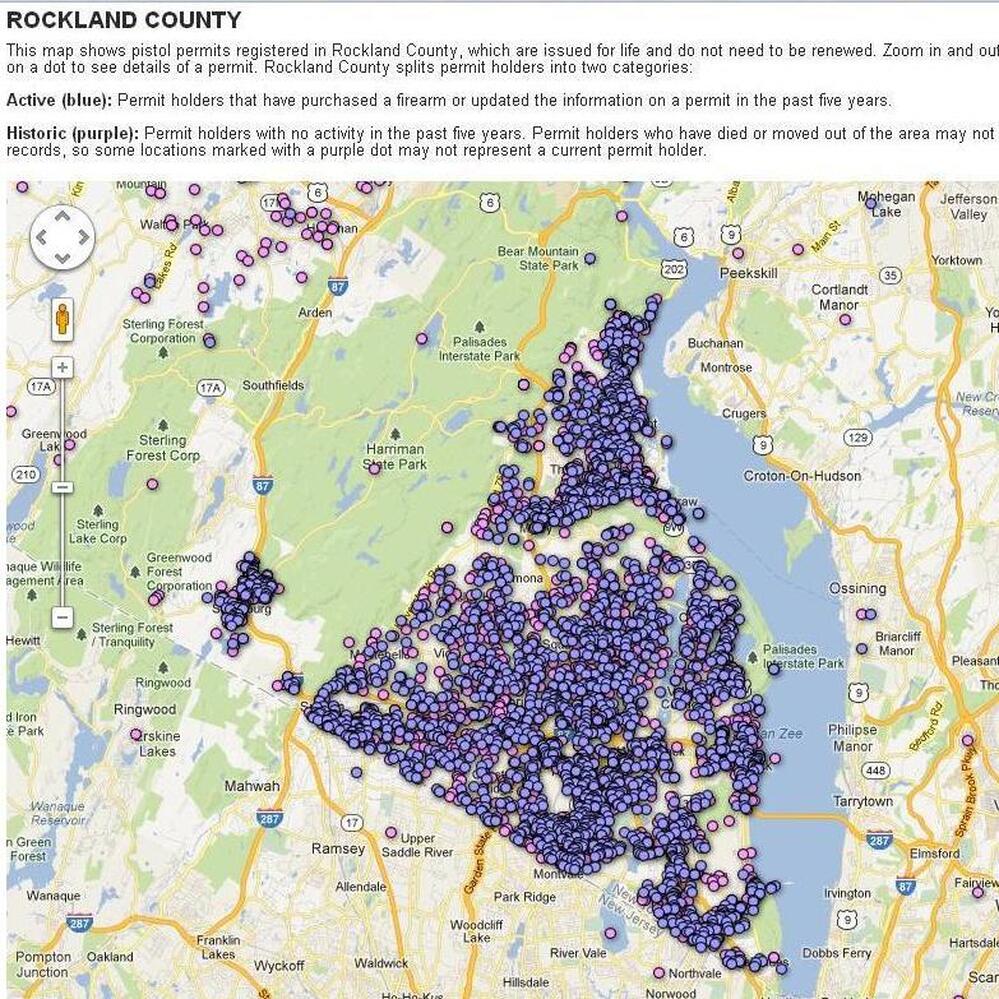 The Journal News' map of gun owners in Rockland County, N.Y. At its website, the image is interactive so that users can see who has handgun permits and where they live.The Journal News
 The data show permits have been issued to "about 44,000 people ... one out of every 23 adults" in the counties, according to the Journal News.
newswell
text
Frontpage
s" target="_blank">It adds that:
"The database, legally obtained from the County Clerks' Offices through a Freedom of Information Act request made after the shootings in Sandy Hook, Conn., that left 20 children and eight adults [including the gunman] dead, has been called irresponsible, dangerous and leaning toward intimidation by online pundits."
Now, the Journal News says it is coming in for strong criticism. "Thousands of people, many from outside Westchester, Rockland and Putnam counties, have taken to their computers and phones in rage," it reports. The critics say the database is "irresponsible, dangerous and leaning toward intimidation by online pundits."
Scott F. Williams, 41, of Haddon Heights, N.J., "called the newspaper's decision to link to the database 'highly Orwellian.'
" 'The implications are mind-boggling,' he said. 'It's as if gun owners are sex offenders (and) to own a handgun risks exposure as if one is a sex offender. It's, in my mind, crazy.' "
According to the Journal News, the map has also "been recommended more than 20,000 times."
Friday, 21 December 2012
Newtown Shooting Prompts 'Bee' Special Edition
The shootings at Sandy Hook Elementary School in Newtown, Conn., last week, hit the community's weekly paper hard. The staff of The Newtown Bee put out the first special edition in the paper's 135-year history.
Copyright © 2012 National Public Radio. For personal, noncommercial use only. See Terms of Use. For other uses, prior permission required.DAVID GREENE, HOST:
Here's the top headline in last Friday's edition of the Newtown Bee: Vandalism leaves old headstones cracked and damaged. Just hours after that edition of the weekly paper was delivered, Newtown became a headline all over the world. Neena Satija of member station WNPR has the story of a small town paper covering and caring for its own.
NEENA SATIJA, BYLINE: The Newtown Bee prides itself on having an intensely local focus. John Voket wrote three of the stories on its front page last Friday, all about the area school district. He's been an editor and reporter with the Bee for the past eight years, and now he's covered just about everything.
JOHN VOKET: From mass shootings to a garden club.
SATIJA: When Voket arrived at Sandy Hook Elementary not long after hearing reports of gunshots and ambulances, he became much more than a journalist. He was getting calls from his sources in the police department and from friends, asking if their children were safe.
VOKET: And then I saw the image that will kind of be burned into my brain, which was these two big state police officers with their Smokey the Bear hats and their bulletproof vests, their arms around each other, heaving in tears. And I knew then that it was really bad.
SATIJA: It was new territory for the family-owned Bee. The publisher found himself out comforting the community, while his staff spent the weekend putting out its first special edition in the paper's 135-year history. Editor Curtis Clark began his career here 40 years ago in this little red wooden house about a mile from the Sandy Hook neighborhood.
CURTIS CLARK: This seemed like something that was putting us in way over our heads.
SATIJA: Colleagues asked each other: How can we write about the mass killing of children who we've seen at the local playground, whose parents we know?
ELIZA HALLABECK: I'm Eliza Hallabeck, the education reporter here at the Newtown Bee. I also live in Sandy Hook.
SATIJA: Hallabeck has spent four years covering school concerts and toy drives and graduation ceremonies in Newtown, including a concert at Sandy Hook Elementary, just two days before the shooting. And so she's seen her role as a reporter here a little differently than the rest of the media.
HALLABECK: We've just been trying to help, because that's all we can do as reporters and as citizens that live here.
SATIJA: The entire staff is juggling reporting while dealing with a phone that never stops ringing.
UNIDENTIFIED WOMAN: Newtown Bee, may I help you?
SATIJA: People keep calling, asking where they can send donations.
UNIDENTIFIED WOMAN #2: At this time, I don't think it's possible for this week. The paper is coming out tomorrow.
SATIJA: And while many other reporters have clamored for access to schools and funerals, staff of the Bee have tried to take a step back, even pleading on Facebook and Twitter for all journalists to stay away from victims' families. Were they asking as members of the community, or of the media? Clark says, they can be both.
CLARK: We felt it was our duty as journalists to say to other journalists, please back off. This is not a service to our readership, and ultimately, it's not a service that anybody's audience is going to appreciate.
SATIJA: This morning's edition is heartbreakingly different than last week's. There are pages of personal messages from members of the Bee staff to their readers. A few stories talk about attempts at a return to normalcy. But for a while, says Clark, the routine at the Bee will be very different.
CLARK: It was not part of our repertoire before to cry as we're doing our job. But we realized in this instance that we were going to do that. So do it, pull yourself together, move on.
SATIJA: Of course, Clark adds, that's also how most people in Newtown are coping. So if his role as a journalist is to hold a mirror to his community, then he's doing exactly that.
For NPR News, I'm Neena Satija.
Copyright © 2012 National Public Radio. All rights reserved. No quotes from the materials contained herein may be used in any media without attribution to National Public Radio. This transcript is provided for personal, noncommercial use only, pursuant to our Terms of Use. Any other use requires NPR's prior permission. Visit our permissions page for further information.NPR transcripts are created on a rush deadline by a contractor for NPR, and accuracy and availability may vary. This text may not be in its final form and may be updated or revised in the future. Please be aware that the authoritative record of NPR's programming is the audio.
Subscribe to:
Comments (Atom)