Audio for this story from Morning Edition will be available at approximately 9:00 a.m. ET.
Sorry, I could not read the content fromt this page.Monday, 31 December 2012

Friday, 28 December 2012
By Showing Ammo Magazine On NBC, Did David Gregory Break The Law?
Washington, D.C., city police are investigating whether NBC News' David Gregory broke the district's laws when he displayed what he said was a "magazine for ammunition that carries 30 bullets" on Sunday's edition of Meet the Press.
As we reported Monday, Gregory picked up and showed the magazine during his conversation with National Rifle Association CEO and Executive Vice President Wayne LaPierre. Gregory asked LaPierre whether it's possible that mass shootings such as the one earlier this month in Newtown, Conn., could be prevented if such high capacity magazines were made illegal. LaPierre said such a ban would do no good because determined killers would find other ways to carry out such attacks.
After Meet the Press aired, some conservative bloggers asked whether Gregory had broken the law.
According to D.C.'s official code:
"No person in the District shall possess, sell, or transfer any large capacity ammunition feeding device regardless of whether the device is attached to a firearm. For the purposes of this subsection, the term 'large capacity ammunition feeding device' means a magazine, belt, drum, feed strip, or similar device that has a capacity of, or that can be readily restored or converted to accept, more than 10 rounds of ammunition. The term 'large capacity ammunition feeding device' shall not include an attached tubular device designed to accept, and capable of operating only with, .22 caliber rimfire ammunition."
Now, as Politico and The Washington Post report, D.C. police confirm they are investigating.
Politico writes that:
" 'The Metropolitan Police Department is investigating this matter," said police officer and spokesman Araz Alali in an interview Tuesday. When pressed on what the police department was investigating, Alali added, 'The Meet the Press, David Gregory incident.
" 'There are D.C. code violations, D.C. code restrictions on guns, ammunition. We are investigating this matter. Beyond the scope of that, I can't comment any further,' he said."
NBC News hasn't yet commented.
Caught On Tape: Words That Haunted In 2012
Weekend Edition Saturday host Scott Simon talks to Esquire Magazine's A.J. Jacobs about some of the people who got caught on tape in 2012 saying things that came back to haunt them.
Copyright © 2012 National Public Radio. For personal, noncommercial use only. See Terms of Use. For other uses, prior permission required.SCOTT SIMON, HOST:
Everybody carries a video recorder around these days - in their cell phone. Yet people, including public people, continue to say things that maybe they'd want to rephrase. AJ Jacobs calls 2012 The Year of Getting Caught on Tape. The author, Esquire Magazine editor, and occasional know-it-all on our program joins us from New York. AJ...
AJ JACOBS: Yes.
SIMON: ...thanks for being with us. By the way, we got people listening now, OK?
JACOBS: I'm going to try to make it through without saying something embarrassing. I know you think that's a long shot, but I'm going to try.
SIMON: Exactly. Well, let's try to get through the first minute. Of course, political gaffes kind of top the list in an election year. Mitt Romney, the Republican presidential candidate, said something in a closed fundraising appearance that got picked up on somebody's cell phone.
MITT ROMNEY: All right. There are 47 percent who are with him, who are rely upon the government, who believe that they are victims, who believe the government has a responsibility to care for them, who believe they're entitled...
SIMON: Now, he later said, you know, he got that 47 percent statistic correct. But how could somebody with all these high-ticket advisors forget that everybody's got a camera in their cell phones these days?
JACOBS: Well, I think we live in the golden age of gaffes. And it's not that we're making more gaffes, it's just that we've said dumb things for all of history. It's just that now every dumb thing we say is recorded and played ad infinitum on the Internet. So, there's no such thing as off the record.
SIMON: Of course, we should note there were a couple of democratic indiscretions too. This romantic recollection, for example, from Vice President Biden:
VICE PRESIDENT JOE BIDEN: I can tell you, and I've known eight presidents, three of them intimately.
(LAUGHTER)
SIMON: Chivalrously, the vice president didn't name the three of them that he's known intimately.
JACOBS: But it's not just politicians. It's everyone, from high to low. There was the Olympic gymnast, McKayla Maroney. And she wasn't caught saying something but she was caught making that famous smirk, that annoyed smirk, when she got the silver medal instead of the gold.
SIMON: But, I mean, but that's made her a star. Even President Obama imitated her smirk when she...
JACOBS: Well, I think she was brilliant, because she owned that smirk. She could have been embarrassed and tried to disown it, but she embraced her smirk and became a superstar.
SIMON: Sometimes words said one context take on a different meaning elsewhere. Paula Broadwell - I'm thinking of this - she appeared on "The Daily Show" to talk about her biography of General Petraeus before her intimacy became known. She talked about the title of her book, "All In."
PAULA BROADWELL: I don't think there's any senior military leader or anyone who's worked closely with him that wouldn't acknowledge that he goes all in to what he does.
(LAUGHTER)
SIMON: Don't say a thing. This is a family show, OK?
JACOBS: OK. Well, I will say one thing that I think is family-friendly, and that is that the General Petraeus affair, I mean, you could not have scripted a better example of how we are in the twilight of privacy and secrecy. Because if the head of the CIA could not keep his affair secret, then there's really no chance for the average Joe.
SIMON: AJ, just in time for the holidays, I gather you have another gaffe to give us?
JACOBS: Yes. There was a woman caught on tape stealing Christmas decorations from a house in Texas.
SIMON: We got a local news report of Ms. Grinch.
(SOUNDBITE OF NEWS BROADCAST)
UNIDENTIFIED WOMAN #1: The family here says their home was hit not only once but twice in one week, and their security camera right there by their front door, well, it caught Mrs. Grinch in the act.
UNIDENTIFIED MAN #1: She gets out, walks up my sidewalk...
UNIDENTIFIED WOMAN #1: ...and goes right for the holiday wreath, taking it off the front door and then walking off to her truck.
SIMON: And I understand the suspected perp is still at large. Listen, AJ, you spent a lot of time this past year recording yourself.
JACOBS: I did an article for Esquire magazine, where I work, and I wanted to take the idea of the recorded life to its logical endpoint. So, I joined this movement, which is called Life Logging. And the idea is that these people record every moment of their lives from morning till night. So, the first time my kid cursed I have it on tape. You know, I was appalled at the time. Yeah, it was a very sweet...
SIMON: How sweet, yeah.
JACOBS: ...thank you. In 10 years, it will be sweet. It was upsetting at the time. But I'm glad I have it. And I have these fights with my wife. So, I would go back and try to, you know, I would say let's replay the fight. But that was actually kind of a disaster, I will admit that was, you know, 'cause it was a lose-lose. If I was wrong then I was flat-out wrong, and if I was right, then she just got angrier.
SIMON: You have, I gather, some audio and video of you playing chess with your son, and what happens?
JACOBS: Well, he was absentmindedly putting the chess pieces on a plate of watermelon. And I asked him to stop and he denied that he was doing it. So, I said, well, let's rewind.
(SOUNDBITE OF VIDEO)
BOY: I'm sorry.
JACOBS: Take it off the plate, please.
BOY: I never put it on that plate.
JACOBS: Who did? Should we check the tape and see if a little goblin came in and put it on the plate?
SIMON: How old's your son, again, AJ?
JACOBS: He is eight years old.
SIMON: Eight years old. So, feel, again, a great sense of satisfaction out of almost outwitting an eight-year-old?
(LAUGHTER)
JACOBS: Almost is an excellent point. Yes. I mean, that was extremely satisfying moment in my parenting.
SIMON: AJ, I hope you and your family, if they're still speaking with you, have a wonderful holiday.
JACOBS: Thank you, Scott.
SIMON: Thanks for dragging us down to your level again.
JACOBS: Of course. My pleasure.
SIMON: AJ Jacobs. The author, most recently, of "Drop Dead Healthy: One Man's Humble Quest for Bodily Perfection."
Copyright © 2012 National Public Radio. All rights reserved. No quotes from the materials contained herein may be used in any media without attribution to National Public Radio. This transcript is provided for personal, noncommercial use only, pursuant to our Terms of Use. Any other use requires NPR's prior permission. Visit our permissions page for further information.NPR transcripts are created on a rush deadline by a contractor for NPR, and accuracy and availability may vary. This text may not be in its final form and may be updated or revised in the future. Please be aware that the authoritative record of NPR's programming is the audio.N.Y. Website Posts Map Of People With Gun Permits, Draws Criticism
The website of New York's Journal News newspapers has posted an interactive map showing the names and addresses of people with licenses to own handguns in three counties just to the north of New York City — Westchester, Rockland and Putnam.
The Journal News' map of gun owners in Rockland County, N.Y. At its website, the image is interactive so that users can see who has handgun permits and where they live.
The Journal News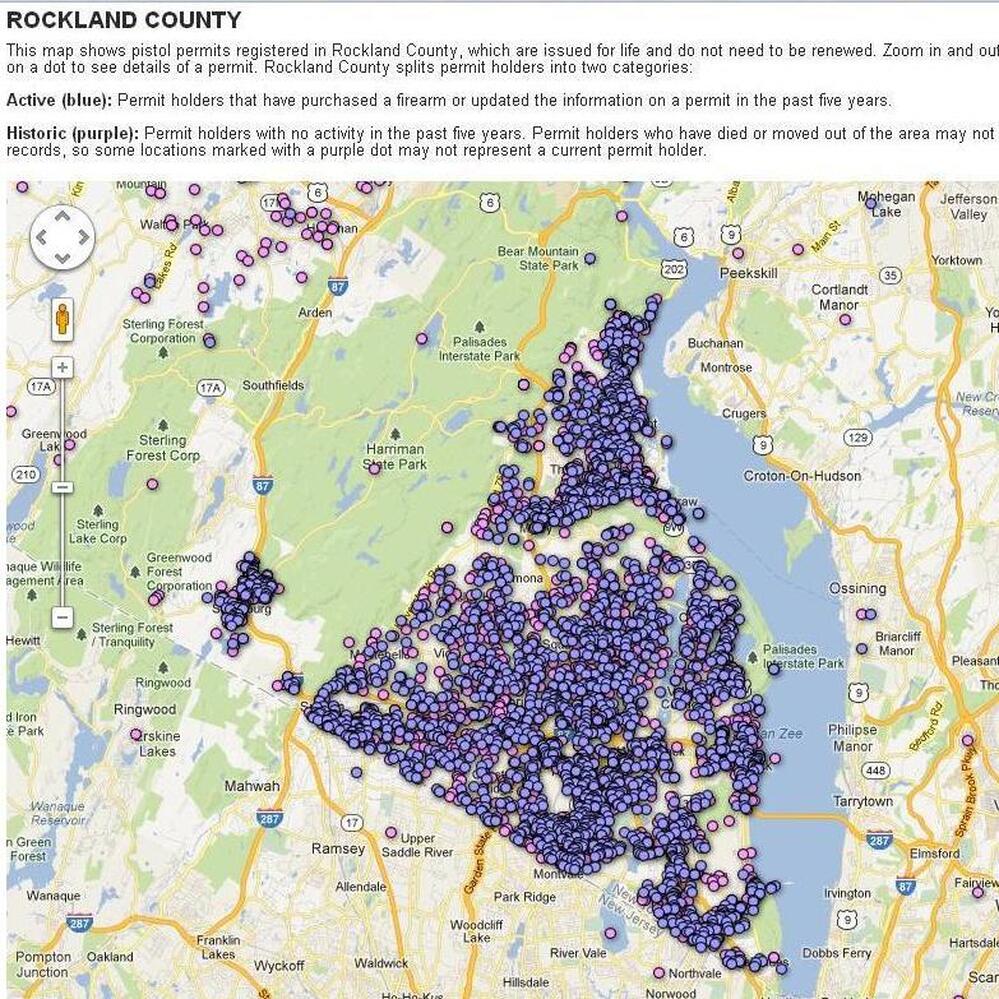 The Journal News' map of gun owners in Rockland County, N.Y. At its website, the image is interactive so that users can see who has handgun permits and where they live.The Journal News
 The data show permits have been issued to "about 44,000 people ... one out of every 23 adults" in the counties, according to the Journal News.
newswell
text
Frontpage
s" target="_blank">It adds that:
"The database, legally obtained from the County Clerks' Offices through a Freedom of Information Act request made after the shootings in Sandy Hook, Conn., that left 20 children and eight adults [including the gunman] dead, has been called irresponsible, dangerous and leaning toward intimidation by online pundits."
Now, the Journal News says it is coming in for strong criticism. "Thousands of people, many from outside Westchester, Rockland and Putnam counties, have taken to their computers and phones in rage," it reports. The critics say the database is "irresponsible, dangerous and leaning toward intimidation by online pundits."
Scott F. Williams, 41, of Haddon Heights, N.J., "called the newspaper's decision to link to the database 'highly Orwellian.'
" 'The implications are mind-boggling,' he said. 'It's as if gun owners are sex offenders (and) to own a handgun risks exposure as if one is a sex offender. It's, in my mind, crazy.' "
According to the Journal News, the map has also "been recommended more than 20,000 times."
Friday, 21 December 2012
Newtown Shooting Prompts 'Bee' Special Edition
The shootings at Sandy Hook Elementary School in Newtown, Conn., last week, hit the community's weekly paper hard. The staff of The Newtown Bee put out the first special edition in the paper's 135-year history.
Copyright © 2012 National Public Radio. For personal, noncommercial use only. See Terms of Use. For other uses, prior permission required.DAVID GREENE, HOST:
Here's the top headline in last Friday's edition of the Newtown Bee: Vandalism leaves old headstones cracked and damaged. Just hours after that edition of the weekly paper was delivered, Newtown became a headline all over the world. Neena Satija of member station WNPR has the story of a small town paper covering and caring for its own.
NEENA SATIJA, BYLINE: The Newtown Bee prides itself on having an intensely local focus. John Voket wrote three of the stories on its front page last Friday, all about the area school district. He's been an editor and reporter with the Bee for the past eight years, and now he's covered just about everything.
JOHN VOKET: From mass shootings to a garden club.
SATIJA: When Voket arrived at Sandy Hook Elementary not long after hearing reports of gunshots and ambulances, he became much more than a journalist. He was getting calls from his sources in the police department and from friends, asking if their children were safe.
VOKET: And then I saw the image that will kind of be burned into my brain, which was these two big state police officers with their Smokey the Bear hats and their bulletproof vests, their arms around each other, heaving in tears. And I knew then that it was really bad.
SATIJA: It was new territory for the family-owned Bee. The publisher found himself out comforting the community, while his staff spent the weekend putting out its first special edition in the paper's 135-year history. Editor Curtis Clark began his career here 40 years ago in this little red wooden house about a mile from the Sandy Hook neighborhood.
CURTIS CLARK: This seemed like something that was putting us in way over our heads.
SATIJA: Colleagues asked each other: How can we write about the mass killing of children who we've seen at the local playground, whose parents we know?
ELIZA HALLABECK: I'm Eliza Hallabeck, the education reporter here at the Newtown Bee. I also live in Sandy Hook.
SATIJA: Hallabeck has spent four years covering school concerts and toy drives and graduation ceremonies in Newtown, including a concert at Sandy Hook Elementary, just two days before the shooting. And so she's seen her role as a reporter here a little differently than the rest of the media.
HALLABECK: We've just been trying to help, because that's all we can do as reporters and as citizens that live here.
SATIJA: The entire staff is juggling reporting while dealing with a phone that never stops ringing.
UNIDENTIFIED WOMAN: Newtown Bee, may I help you?
SATIJA: People keep calling, asking where they can send donations.
UNIDENTIFIED WOMAN #2: At this time, I don't think it's possible for this week. The paper is coming out tomorrow.
SATIJA: And while many other reporters have clamored for access to schools and funerals, staff of the Bee have tried to take a step back, even pleading on Facebook and Twitter for all journalists to stay away from victims' families. Were they asking as members of the community, or of the media? Clark says, they can be both.
CLARK: We felt it was our duty as journalists to say to other journalists, please back off. This is not a service to our readership, and ultimately, it's not a service that anybody's audience is going to appreciate.
SATIJA: This morning's edition is heartbreakingly different than last week's. There are pages of personal messages from members of the Bee staff to their readers. A few stories talk about attempts at a return to normalcy. But for a while, says Clark, the routine at the Bee will be very different.
CLARK: It was not part of our repertoire before to cry as we're doing our job. But we realized in this instance that we were going to do that. So do it, pull yourself together, move on.
SATIJA: Of course, Clark adds, that's also how most people in Newtown are coping. So if his role as a journalist is to hold a mirror to his community, then he's doing exactly that.
For NPR News, I'm Neena Satija.
Copyright © 2012 National Public Radio. All rights reserved. No quotes from the materials contained herein may be used in any media without attribution to National Public Radio. This transcript is provided for personal, noncommercial use only, pursuant to our Terms of Use. Any other use requires NPR's prior permission. Visit our permissions page for further information.NPR transcripts are created on a rush deadline by a contractor for NPR, and accuracy and availability may vary. This text may not be in its final form and may be updated or revised in the future. Please be aware that the authoritative record of NPR's programming is the audio.In Christmas Message, Queen Elizabeth Returns To 3-D After 59 Years
Queen Elizabeth II wears 3-D glasses during a visit to the University of Sheffield, in 2010. This year, the queen's annual Christmas message will broadcast in 3-D.
WPA Pool/Getty Images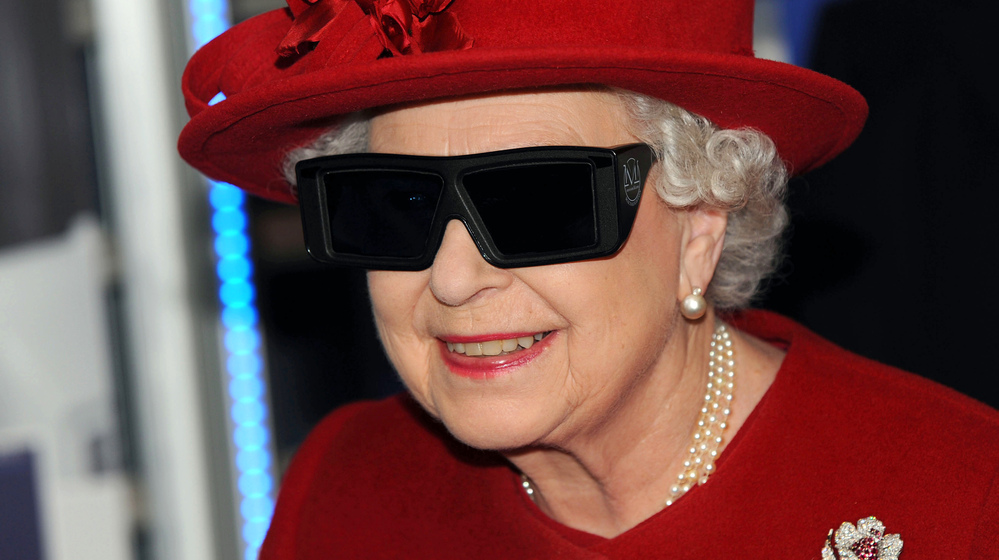 Queen Elizabeth II wears 3-D glasses during a visit to the University of Sheffield, in 2010. This year, the queen's annual Christmas message will broadcast in 3-D.WPA Pool/Getty Images
 It's been 80 years since Britain's royal family began broadcasting a Christmas message — and 60 years since Queen Elizabeth took up the duty. Now, the monarch will deliver her 2012 holiday address in 3-D.
The TV broadcast is the latest innovation for a message that began as a radio transmission by the queen's grandfather, King George V. Queen Elizabeth's Christmas message has also been podcast since 2006; one year later, she took to YouTube to spread her message, according to the British monarchy's website.
But this year's broadcast is not the first time the queen has been filmed in 3-D. That moment came in the summer of 1953, when the coronation of the queen, then 27, was filmed by a two-man crew. Footage of that event, and others from the same summer, wasn't made public until 2009. Here's a clip, which you can fully enjoy if you have 3-D glasses handy:
One of the men who shot that film, Arthur Wooster, recalls that Queen Elizabeth had a knack for the camera — and that at one point in the clip above, with only his crew filming as she approached, the queen obviously noticed their cameras.
"But she didn't allow herself to look at it. She deliberately walked straight past us, giving us one of the few close-up shots ever taken of the young Queen," Wooster, who was 24 at the time, told The Daily Mail. "I was knocked back by her beauty. She radiated film-star quality.'
The British monarchy's website says the queen's 2012 Christmas Day message will be broadcast at 3 p.m. — that's 10 a.m. ET, here in the U.S.
In Britain, the royal Christmas messages are seen a chance for the monarch to communicate directly with the public. Queen Elizabeth reportedly writes her own speeches for the occasion. Here's what the queen told her people back in 1952, according to a transcript of the live radio broadcast:
"Many grave problems and difficulties confront us all, but with a new faith in the old and splendid beliefs given us by our forefathers, and the strength to venture beyond the safeties of the past, I know we shall be worthy of our duty."
"Above all, we must keep alive that courageous spirit of adventure that is the finest quality of youth; and by youth I do not just mean those who are young in years; I mean too all those who are young in heart, no matter how old they may be. That spirit still flourishes in this old country and in all the younger countries of our Commonwealth."
Thursday, 20 December 2012
What The Media Got Wrong In The Newtown Story
In the hours following the Newtown, Conn. shooting, several initial media reports provided false information. For example, the gunman's brother was originally identified as the shooter. NPR's media correspondent David Folkenflik explains how and why the media falsely reported key details.
Copyright © 2012 National Public Radio. For personal, noncommercial use only. See Terms of Use. For other uses, prior permission required.NEAL CONAN, HOST:
Soon after the horrible murders last Friday in Newtown, Connecticut, we had an idea on the shooter, the possibility of a second suspect, and a plausible motive - except all those stories were wrong. Media outlets, including NPR, made mistakes on some or all of those key fact. We now know that Adam Lanza carried out the killings, not his brother Ryan, who was never a suspect, that their mother, Nancy, was shot and killed at her home, not at the Sandy Hook Elementary School, where she did not teach, substitute teach or volunteer.
So how could news organizations get such key details wrong? NPR media correspondent David Folkenflik has been reporting on how and why news organizations made such mistakes. He joins us now from our bureau in New York. And David, always nice to have you on the program.
DAVID FOLKENFLIK, BYLINE: Good to join you, Neal.
CONAN: And let's start with the big one the media got wrong, the identity of the shooter. How and why did so many news organizations report that Ryan Lanza, the brother, was the shooter and not Adam?
FOLKENFLIK: Well, look, this is a case where reporters for a variety of news organizations - led seemingly mostly by some of their brethren in the TV world - were reporting what was genuinely being told to them by law enforcement officials.
On the other hand, I think there was an incredible echo chamber here, as tends to happen when there are very few genuinely authoritative sources, where, you know, reporters, particularly those based in places like Washington and New York, where their expertise are with federal law enforcement agencies, are saying, what do you got? What have you heard? And yes, they too had heard that it was Ryan Lanza, incorrectly, we want to stress, but that Ryan Lanza was somehow the person who is believed to have been the shooter in these terrible, terrible killings.
And people got what they felt was confirmation of other media reports and they went with it. It is an understandable impulse in the minutes and hours after a terrible event to try to say definitively what's happened. But as often as not, a lot of the key details get to be wrongly presented on the air and in print.
CONAN: And let's square up. NPR got some of them wrong too.
FOLKENFLIK: That's absolutely the case, also done on the basis of things that have been told to us by law enforcement officials. But I think there are a couple of important, you know, things to think about here, and they come up time and again in stories that are unexpected, particularly that are catastrophic in some way, and that attract an extraordinary amount of public and media attention. And that's a question of not only having sources but being clear with yourself on how authoritative a source is, how close is the source to the original information itself, how convinced are you that that person is hearing something not just fifth, sixth, seventh hand and saying, yeah, I heard that too but I'm telling you that, in good faith, and I am, you know, a responsible federal or state official, and therefore, you know, you're - you tend to give them credence, particularly when the clamor for some sort of concrete tangible information is so great.
CONAN: And so many of the news outlets said afterwards, we went to - we got this information from sources we trusted and our trust was misplaced.
FOLKENFLIK: And they would say the same. But you know, in any incident - and, you know, we can talk a bit about how accelerated it is in this day and age, but in any time, going back to, you know, the Oklahoma City bombing, going back - I looked at tapes of the attempted assassination of President Reagan in 1981, I believe, and you saw the anchor for ABC News, Frank Reynolds, angrily, on the air, on the phone, trying to elicit(ph) understanding of what had happened to President Reagan when he was whisked away after being shot.
Jim Brady, after whom the White House briefing room is named currently, who survived that day, was pronounced dead on all three major television networks at the time. So it's not simply about this day and age. It's about the nature of gathering information and the seeming imperative, often self-imposed but then nonetheless desire by the public, to deliver, you know, some sense of what are the facts and what are the narratives that you can stick the facts into.
CONAN: And the most compelling narrative was the one of motive. Why did this happen? And that led to the round-and-about circulation of the story - well, he was angry at his mother, killed her first as she was teaching the kindergarten class that she taught at Sandy Hook Elementary School. All of the facts were wrong.
FOLKENFLIK: Well, to me what was the most sadly compelling statement that I heard at one point was the principal had buzzed him in because she recognized the shooter as a son of one of her colleagues, a teacher at the school. None of those things were true. She didn't - we have no evidence she recognized the shooter. We have no evidence that - in fact, we know that she didn't buzz him and...
CONAN: He forced his way in.
FOLKENFLIK: He forced his way in. And she was not a teacher there. So in that single sentence, which seems to suggest action and seems to suggest - takes you to a place where you have sort of a mind's eye vision of what occurred, which gives you some sense of ownership and mastery over this terrible, terrible event, none of that was, in fact, the case. You know, you had people on the air saying, well, we're told that he had Asperger's, and here is how that could have contributed to the constellation of events leading to this.
You know, there is no scientific evidence to indicate or studies that would support the idea that people with Asperger's, which has just been removed from the DSM, you know, would contribute in any way to such a violent act. You know, there's just a series of things that we do based on totally wrong information and tips, and then there's stuff that we do that get out ahead of the fact.
CONAN: You've pointed out that we - before the age of cable TV news - got facts wrong plenty of the times before. Yet there is that competition from the cable news channels that are on the - those TVs are on the wall on every newsroom around the country no matter what kind of news outlet you are. There is also competition from social media, from Twitter and Facebook and the feeling that the old fuddy-duddy media doesn't want to be left behind.
FOLKENFLIK: Right. Well, look, you know, when President Kennedy was assassinated in Dallas in 1963, as I understand it fisticuffs broke out over wire reporters trying to use the payphone, over who could get their dispatches in most as quickly. But I think it's worth pointing out a couple of signal moments, each of which have accelerated the pace of the news. So the addition of CNN meant that there was 24-hour news.
You didn't have to break into the soap operas or the evening dramas. You are on the air live at all time. And there was a hunger for material to use, and an event like this became, you know, grist for that. In 1996 there were additional cable channels where suddenly CNN had to compete with others that were on its, you know, own wavelength in terms of the need to be on the air as quickly as possible.
Then, you know, in 1996 also, the Web became more of a consumer thing, and suddenly you had websites that had started to develop their own news staffers. And that accelerated things because you could publish, you know, minute by minute, not just hour by hour. Well, suddenly with social media, call it five years ago, whatever point you want take it from, you have Twitter, you have Tumblr, you have Facebook. And people can do things for themselves.
So, for example, I talked the other day with Ben Smith. He's the editor in chief of BuzzFeed, which kind of straddles digital media and reporting, certain kind of old school values, with the social media world. And he said, look, we took CNN's confirmation that Ryan Lanza, the older brother, was the shooter. Wrongly again, we stress. And so we went and we started scraping his Facebook page for images, for postings to see what it was like. Other people posted some of the things that he had said on Twitter and indicated, well, it's a despondent state of mind.
Maybe so, but he didn't happen to be the killer. But instead you're cementing in people's minds, and in the aggregate of all these actions by all these various news outlets, millions of people's minds, for many hours, thought that Ryan Lanza was a mass murderer when he wasn't. Social media advocates will say, well, we're only doing what our audiences are doing for themselves. But certainly we're all responsible for what we do.
And when you lend the imprimatur, as major news outlets did and the social media outlets did, to the idea that the mistaken person is actually the culpable party, I think you're giving a more conventional seal of approval to the information.
CONAN: You left out another significant moment, David. It was the moment when - I'm old enough to remember when the news came over wire machines that chugged and sumped out characters at the remarkable speed of 60 characters a minute and printed out on paper the news as it came in. The wire services were the fastest form of communication of the news in those days, and you had to wait for the story to finish until it was finally printed out. Then the wires went digital, and all of that information from all of the wire services was available instantly and it completely transformed the news business.
FOLKENFLIK: I think that's exactly right. I mean when you're going into binary code that can suddenly show up on our own terminals, not just as presented by people at CBS or in print by The New York Times, it changes the nature of our relationship to the news.
CONAN: Then there are other controversies. Getting it wrong is one thing, but there are other controversies that have not changed over time. And that is the sense of people in a town the size of Newtown - when a story breaks there, you can feel overwhelmed by what seems like an occupying army.
FOLKENFLIK: And that's a completely understandable reaction to it. I think different residents, different survivors of that incident are going to react differently. You know, this is a calamity that has happened to a small community. It is also one that's been wreaked on, you know, Connecticut and on the nation at large. It's clearly something that has commanded the attention of every person up to the president of the United States. And so the idea that we would somehow not pay attention to it, leave it only to the foreign tabloids that think that America is only a violent place, somehow doesn't quite make sense to me. And yet you do have these throngs of reporters, you know, overwhelming the number of residents in certain clusters of interviews by probably a couple dozen to one, that seem to be all - out of all balance. And there has to be some understanding of the human situation that the survivors have gone through and some calibration of what are we focusing on here and are we being constructive or destructive in doing it.
I don't think it's true that the press should simply walk away. I think some of the anger at the press is displaced because of the, you know, more generalized anger and anguish over what actually occurred. But I think it's a very real and valid complaint to say, you know, are we adding something here or are we just trying to put our own brand and imprimatur on an interview you've seen in eight other places.
CONAN: We're talking with NPR media correspondent David Folkenflik about how and why the media got so much wrong in the Newtown, Connecticut horror story last week, last Friday. You're listening to TALK OF THE NATION from NPR News. And let's get a caller in on this. Karen's on the line from Clinton in Connecticut.
KAREN: Yes, hi. In terms of wrongly reporting information with the brother - regarding the brother - another thing that I did not hear mentioned is that it actually potentially put the brother - the innocent brother in danger because someone who thinks that they're going to be a hero or a do-gooder who could attempt to harm the brother, it can happen by putting wrong information out there.
CONAN: Yeah, some sort of crazy citizen's arrest or something like that. David, she's got a point.
FOLKENFLIK: Oh, I think she's...
KAREN: Exactly. Arrest is just the least amount; could be worse than arrest.
FOLKENFLIK: Right. Well, you know, look, it is - certainly Ryan Lanza's life has been wrecked by the actions of his brother: killing his mother, killing all those people at the school and killing himself. But that said, you know, there's no reason for Ryan Lanza to have been thought by millions, probably tens of millions of people, for the better part of an entire day to have been a mass murderer, that it's hard to unring that bell even though social media and the digital media allows the corrections to arrive much more quickly than it once might have done.
I think there is something to be said for journalists being careful. I mean, certain things are going to be true regardless of how quickly we raced to report it before the official pronouncement. A certain number of people are going to be dead. The body is going to turn - of the killer is going to turn out to have been a specific person. And it seems to me that if we don't have this information authoritatively as journalists, we've got to question, you know, both how we have it exactly sourced and also what value it provides in releasing that information publicly before a public official is putting his or her name to it.
The second thing I would say is that just as consumers of the news, as citizens, it's probably on us to recognize that if we choose to follow these catastrophes that are unfolding in real time as information is unclear, we have to understand that a lot of the narratives that are going to be provided to us, a lot of the explanations and information that's going to be served up on the air and online, is going to turn out not to be true.
And almost overwhelmingly that's going to be - have been presented in good faith, but we're going to have to take more responsibility for ourselves as discerning consumers and say we have bought into this exceptionally accelerated pace of news presentation. We have to acknowledge that comes at a cost of precision.
CONAN: Karen...
KAREN: Exactly. Because what is the priority? Is it to be the first person to report and get the audience, or is it to report accurately?
CONAN: You raised a critical question, Karen, one that the news media has been trying to answer for many years. And David, your point is also buttressed by - you go back to Columbine, not all that long ago. And it was 10 years that the narrative was this was the Trenchcoat Mafia, these were kids retaliating against the jocks who'd bullied them mercilessly. All turned out to be wrong, and we didn't know that for about 10 years.
FOLKENFLIK: That's right. I spoke with Dave Cullen, who took a decade trying to wrap his mind around how to approach this and wrote a book about the shootings in Littleton, Colorado, which, you know, sort of presaged the devastation that we all felt at these shootings more recently in Connecticut. And, you know, he said exactly as you said. You know, we all thought these were goths, the uncool kids who were taking out their vengeance, particularly on jocks who had hazed them relentlessly.
And you know, one of the things he pointed out was, look, they had planned to set off bombs all over the school. This was going to be indiscriminate killing. Every element, as you say, of that narrative was wrong. The press had decided within about 72 hours or so that it was satisfied that that was, however, what had occurred, and it kind of held on to that.
And so, you know, we really need to be careful as journalists and citizens, as - to looking carefully about how we know facts, how we know what we know to be true and are being presented as fact, and also what then we do in terms of linking dots to make a greater narrative and story out of that.
CONAN: And is there any way to remind reporters and news organizations and - this is not just young kids. These are graybeards like you and me, David.
(LAUGHTER)
FOLKENFLIK: Salt and pepper, Neal. Salt and pepper.
CONAN: Well, speak for yourself. The - some of the facts that are being reported in this first break in this breaking story are going to be untrue. Be careful.
FOLKENFLIK: Well, you know, you do see that. There are points at which - you saw a number of people on cable news talk saying, you know, this is a fluid story. The facts are moving. And it's really - what they're saying is the information we're presenting you is shifting around. You don't see a lot of people saying we want to correct what we say before. They say, you know, there are new developments. There's new information in. The word new is almost a trigger for revision in this day and age, you know, unless, you know, you have no information having been presented.
What they're really saying is, we're able to sift the wheat from the chaff here. We're able to figure out a little more definitively what's going on. They're using shorthands that mean something to journalists. I'm not sure the public totally understands - and reasonably so - that what they're really saying is we're going to tell you almost a fire hose of information here because we're not able to discern entirely what's real and what's not. There's just so much coming at you. You know, there's so much chatter, we're trying to figure out what the real voice of truth is here.
CONAN: David, thanks very much for your time, as always.
FOLKENFLIK: You bet.
CONAN: NPR media correspondent David Folkenflik, with us from our bureau in New York. Tomorrow, a holiday celebration with Ensemble Galilei. Be sure to join us for that. It's the TALK OF THE NATION from NPR News. I'm Neal Conan in Washington.
Copyright © 2012 National Public Radio. All rights reserved. No quotes from the materials contained herein may be used in any media without attribution to National Public Radio. This transcript is provided for personal, noncommercial use only, pursuant to our Terms of Use. Any other use requires NPR's prior permission. Visit our permissions page for further information.NPR transcripts are created on a rush deadline by a contractor for NPR, and accuracy and availability may vary. This text may not be in its final form and may be updated or revised in the future. Please be aware that the authoritative record of NPR's programming is the audio.Coverage Rapid, And Often Wrong, In Tragedy's Early Hours
Flowers, candles and stuffed animals make up a makeshift memorial in Newtown, Conn., on Monday. Much of the initial news coverage of Friday's events was later found to be inaccurate.
Eric Thayer/Reuters/Landov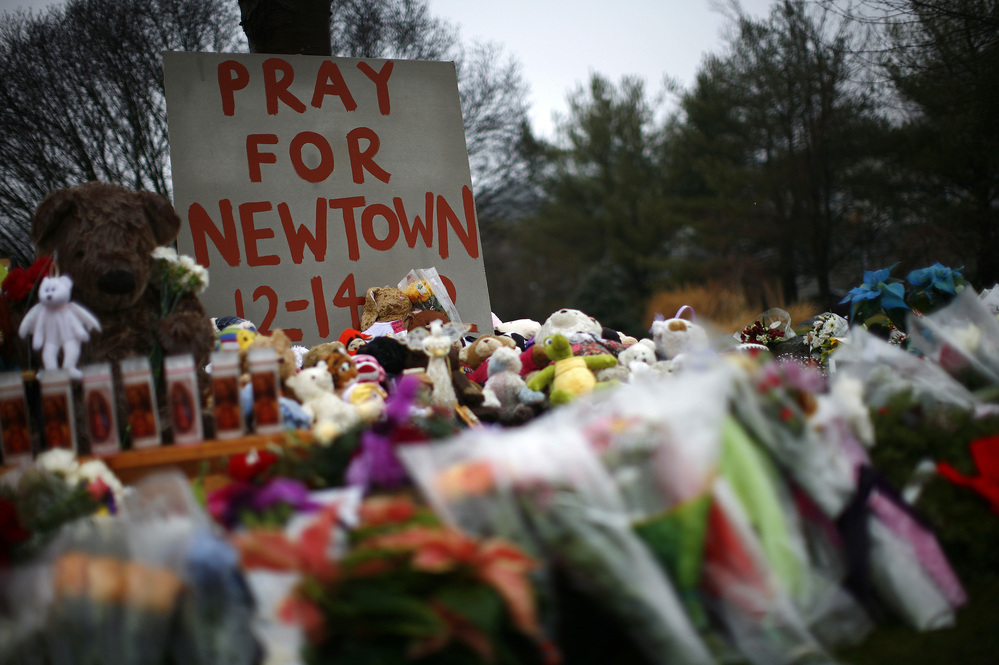 Flowers, candles and stuffed animals make up a makeshift memorial in Newtown, Conn., on Monday. Much of the initial news coverage of Friday's events was later found to be inaccurate.Eric Thayer/Reuters/Landov
 Nearly everyone reported so many things wrong in the first 24 hours after the Sandy Hook shootings that it's hard to single out any one news organization or reporter for criticism.
Among the news outlets that wrongly reported major parts of the journalistic building blocks of "who, what, where, when, why and how," were CBS, The Associated Press, The New York Times and NPR — a veritable honor roll of the mainstream media. Many of the reports relied on unnamed law enforcement officials, typically federal, or even the vaguer "the authorities," in at least one instance.
The Story Behind A Striking Image Of The Scene At Sandy Hook
In a photograph taken by Shannon Hicks, police and teachers lead children away from Sandy Hook Elementary. Hicks is a volunteer firefighter, in addition to being an associate editor at the local paper.
Shannon Hicks/AP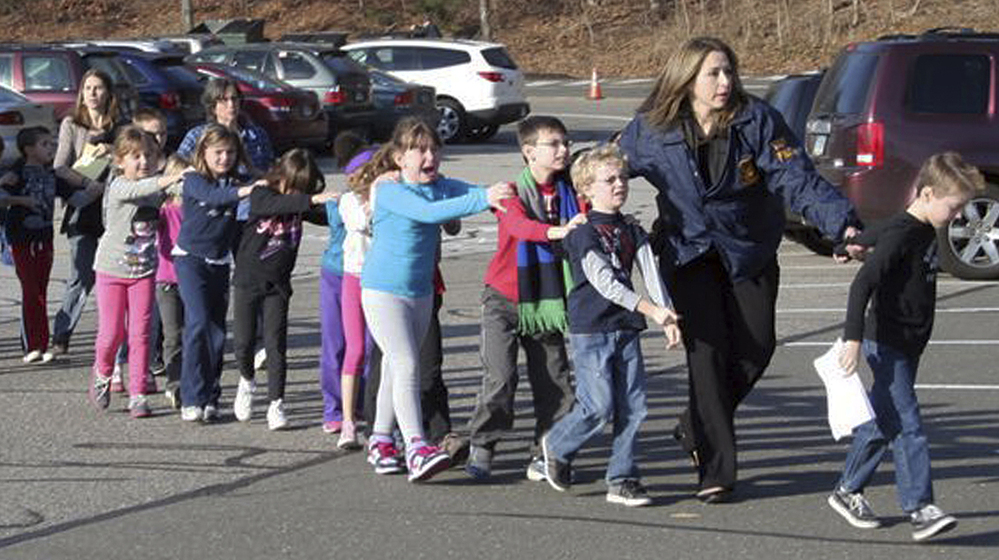 In a photograph taken by Shannon Hicks, police and teachers lead children away from Sandy Hook Elementary. Hicks is a volunteer firefighter, in addition to being an associate editor at the local paper.Shannon Hicks/AP
 Moments after a brutal attack began at an elementary school in Newtown, Conn., Friday, Shannon Hicks sped to the scene. She was responding in two capacities: as a volunteer firefighter, and as an employee of the local weekly newspaper, The Newtown Bee.
After arriving on the heels of the first batch of responders, Hicks juggled responsibilities in her two roles. Along the way, she helped define a senseless tragedy that has yet to be fully understood, or explained.
As she tells the Poynter Institute, Hicks was at the Bee's offices when the alert of a shooting went out on a police scanner. She immediately drove to Sandy Hook Elementary, less than two miles away.
When she pulled up, Hicks saw a line of children being led away. She snapped a photograph, with one hand on the wheel and the other holding her camera. Soon afterward, the image was beamed by news TV channels and websites, as her newspaper complied with a request from the AP to provide the photo for wider distribution.
For many people, that photo has become a lasting image of the horrible tragedy in Newtown, capturing the innocence of the young children at the school, and the terror and panic that erupted when a gunman opened fire inside its walls.
As Poynter's Julie Moos writes, after she took the photo, Hicks stayed on the scene as an associate editor of her paper. But when another editor arrived, she changed into her firefighting uniform and tried to help. Afterward, she returned to work at the newspaper's offices.
Of her photograph's wide dissemination, Hicks says she has mixed feelings — especially because in the tragedy's aftermath, many view it is inappropriate for news media to interview or photograph children who were at the school.
As Poynter's Julie Moos writes:
"Hicks was aware the photo was on the front page of Saturday's New York Times (her mother told her), but was unaware it was on the cover of many other newspapers across the U.S.
"'I'm conflicted,' she said. 'I don't want people to be upset with me, and I do appreciate the journalists, especially, who have commented, saying 'We're just documenting the news.'"
"It's harder when it's in your hometown and these are children we're gonna watch grow up, the ones who made it. I know people are gonna be upset, but at the same time I felt I was doing something important."
While it's only published once a week, The Newtown Bee has used its website, Twitter feed and Facebook page to update its readers, and to relate how a community is enduring a tragedy that put its small town on the national map.
The 'Calm Act' Will Quiet Down Commercials, So What Should Congress Do Next?
iStockphoto.com 
COME RIGHT DOWN RIGHT NOW BUY SOME FURNITURE EVERYTHING MUST GO WE ARE LIQUIDATING MERCHANDISE FOR THE THIRD TIME SINCE LAST FEBRUARY AND THIS TIME WE REALLY MEAN IT WE ARE GOING OUT OF BUSINESS ANY REASONABLE OFFER WILL BE ACCEPTED OR MY NAME ISN'T CRAZYPANTS MCGILLICUDDY.*
If this is what television commercials sound like to you, Congress has you covered. Beginning today, because of the "CALM Act" (it stands for Commercial Advertisement Loudness Mitigation), by federal law and accompanying FCC regulations, commercials aren't allowed to be any louder on average than the shows they accompany. This should mean that you won't have to ... well, it wouldn't be "jump out of your chair," since we don't do that anymore, but you won't have to jerk your arm up from the armrest and knock over your glass as you grab for the remote and reduce the volume because all of a sudden, the man from the furniture store is screaming at you about THE LOWEST PRICES.
But let's not give up our momentum. My ears demand more help! No taxation without noise mitigation! Pass these now, before it gets loud again!
1. The Pokemon Electronic Whizbang Popcap EA Worldofwarcraft Put an End to it Would you Act (PEWPEWPEW): Requires anyone playing a video game in the presence of others for more than five minutes to offer to turn off or turn down any incidental music, monkey noises, pops, zaps, bloops, and voices saying "FINISH HIM."
2. The Construction Hurts Everyone Really Everywhere Act (C-HERE). Authorizes anyone living or working within two blocks of a piledriver to lean out the window and scream, "NOW SEE HERE," at which point the operator of the piledriver must apologize profusely and desist immediately.
3. The Well, I Live Downstairs, And That Hurts Ears And Ruins Things Act (WILD AT HEART). Does not allow anyone with neighbors to own instruments on a list to be established by regulation by the FCC, which must include but not be limited to drums, bagpipes, and trumpets.
4. The Bass Mitigation and Minimization and Booming Metal Moderation Act (BMM-BMM). Defines as "intolerable vibrating noise" anything that allows identification of the bass line but does not transmit the melody.
5. The Sidewalk Noises Of Winter Just Eliminate Real Kindness Act (SNOW JERK). Requires anyone who runs a snowblower before 9:00 in the morning on a weekend to blow the snow off of everyone's driveway in the entire neighborhood, and then serve hot chocolate, and then stop doing that forever.
*NO BACKSIES.
Documenting Tragedy: The Ethics Of Photojournalism
David Folkenflik, media correspondent, NPR
Kelly McBride, senior faculty in ethics, reporting, and writing, Poynter Institute
Stephen Mayes, managing director, VII Photo Agency
When the New York Post published a freelancer's photograph of a man trapped in the path of an oncoming subway train, many photojournalists, editors and consumers decried the decision as unethical. Others argue that the photo was essential to the story.
Copyright © 2012 National Public Radio. For personal, noncommercial use only. See Terms of Use. For other uses, prior permission required.ARI SHAPIRO, HOST:
This is TALK OF THE NATION. I'm Ari Shapiro, in Washington, sitting in for Neal Conan. Last night, a man was arraigned and charged with second-degree murder for allegedly pushing someone into the path of an oncoming New York subway train. This hour we'll talk about the photograph that made Ki-Suck Han's death a national topic of debate.
The New York Post published this chilling image on its cover. The photo shows a man in the path of an oncoming train with the headline: "Doomed: Pushed on the Subway Track, This Man is About to Die." The entire horrifying episode has sparked a conversation about how we capture and share images of tragedy.
Photojournalists and editors, we want to hear from you this hour. Tell us about a time you had to make a tough call, whether to share a troubling image. Our phone number is 1-800-989-8255. You can email us at talk@npr.org, and you can also join the conversation at our website. Go to npr.org, and click on TALK OF THE NATION.
Later in this program, Rhode Island Senator Sheldon Whitehouse on the fiscal cliff. But first the photo everyone's talking about, and we begin with NPR media correspondent David Folkenflik. He's following this story, and joins us from the New York bureau. Hi, David.
DAVID FOLKENFLIK, BYLINE: Hey, Ari.
SHAPIRO: Before we get to the ethics of what happened, describe what we know. What are the facts of this story?
FOLKENFLIK: Well the facts are fairly straightforward. There was an altercation, you know, at a subway stop here in Midtown Manhattan. Folks were waiting for the Q Line, saw an altercation between the gentleman you mentioned, Ki-Suck Han, he's 61 years old, and a person later identified by police as Naeem Davis, a 30-year-old man. Some eyewitnesses later described Mr. Han to news outlets as having been a little bit aggressive and contentious.
The person identified by police as Davis pushed the man, and he tumbled into, you know, the tracks themselves. The Q Train was coming. He, as the photograph showed that you described, is literally trying to get himself back up onto the platform and cannot do it. And the train strikes and kills him.
Onlookers, you know, pull him back up afterward. A lot of questions raised as the photograph itself raised about the Post, questions were later raised both about onlookers, could they have done more and also whether the photographer himself should have done more rather than trying to take that picture.
SHAPIRO: Most people first heard about this story when they saw the cover of the New York Post, and there was an immediate outcry, as we said, against the photographer. What have we heard from him, and what has he said about what happened in those moments?
FOLKENFLIK: Well, his name is Umar Abbasi. He's been a photographer I believe on contract with the New York Post. Tabloids tend to have a lot of people on contract and freelancers rather than simply having a stable only because photographs are so important to the visual kind of storytelling in tabloid gossip, celebrity, crime, violence that so much is a staple of what they offer.
He says look, headline in front of me, he writes a little essay in the Post yesterday that says anguished photog, critics are unfair to condemn me. What he said after being criticized, ultimately by people as prominent as Al Roker of "The Today Show," CNN's Anderson Cooper, they said put down the camera, fellow, and go help this guy.
He said I was far too far away to help, myself. He said he took pictures in order to set off the flash to warn and alert the person driving the train to try to get them to put on the emergency brake. He did take 49 pictures, and people took that as evidence somehow that he had a lot of time to spare.
Actually, if you think about the way modern digital cameras work, you know, the camera, if you just hold it down, it's going to take shot after shot after shot after shot. He says I couldn't do anything, I responded as a photographer. There were people far closer than me. None of us reacted in there.
A lot of them, they said, were afraid of the way in which the gentleman who had pushed the victim down onto the tracks, was behaving up there.
SHAPIRO: I understand the photographer has also said he was paid for the photograph by the Post, as photographers are when their images are published. The Post has taken some heat for publishing the photo with this headline, doomed. Tell us about how they've reacted.
FOLKENFLIK: The Post has reacted by publishing day after day after day of front-page stories on this. You know, they are in a sense milking this horrific story, as tabloids are wont to do. It's a grisly, terrible story. The original photograph, if you see it, and we're one of the few news outlets that can talk about it without reproducing it as we're doing so, although obviously on our website we have to make choices ourselves, but the photograph in a sense is - evokes the notion of a snuff film.
I mean, you're seeing a guy moments before he's about to actually be killed, and that's a very rare image to capture. It's visceral and haunting, even though you're not seeing the actual violence occur quite yet. So the Post is taking heat, and the Post is liking the attention.
I mean, they're letting the photographer speak for them, in a sense, and they're letting their front page speak for them by reproducing the story in subsequent days.
SHAPIRO: Are there any hard and fast rules about this kind of situation for photojournalists, for newspapers that may publish those images?
FOLKENFLIK: There aren't hard and fast rules. In talking to journalists and news editors, people who are thinking about this issue and issues like this one, you know, they're trying to say what's the public good weighing what's the private pain that's incurred and also what's the effect on people who are going to see this.
After all, if you're putting this on the front page of the New York Post, you're ensuring that people and schoolchildren of, you know, all the neighborhoods in New York are going to see this on the newsstand. After all, that's how the Post is largely distributed. So you've got to think: Is this going to be too upsetting for the public to handle? Is this going to be too upsetting for the family, which has said publicly now that it is absolutely ravaged and distraught by this image?
Or is there a public good being served? I think it's - there's a public good being served in the notion that you are evoking the horror of this moment, you are making clear that it's - you're not sanitizing what violence is person-on-person. On the other hand, you know, you don't have to see all the grisliness of a murder victim to know that a murder is terrible and horrible.
And, you know, our standards in this country, while not hard and fast, as you say, are a lot less likely to be bloody than if you were to look at newspapers in particularly Latin America or other parts of the world.
SHAPIRO: We're going to hear from experts this hour who hold both views, that it should and that it should not have been published. But David, I want to ask you: Is there any difference when you're talking about what you described as tabloid journalism, something like the New York Post in contrast to the Wall Street Journal or the Financial Times?
FOLKENFLIK: Well, I don't think you'd find too many people at the Wall Street Journal or the Financial Times finding a specific instance of violence to be as interesting, unless it's evoking a greater truth. You know, you could see something that showed the horrors of genocide in the Balkans or Rwanda. Or you could show a dead body or some sort of atrocity being committed as a way of bringing attention of the world on something that they needed to bear witness to.
You know, ordinary crime is not something that you see - the prestige - broadsheet newspapers giving that kind of coverage to, nor typically the more prestigious, you know, broadcast news outlets. A tabloid, you know, local news and violence and crime is the texture or the warp and woof of what it does on a daily basis.
And, you know, for them, the controversy is not something to be avoided but courted. You know, I don't see this as being something where it's a gaffe on their part. I think they thought we have something gripping and visceral that everyone will be talking about it, and we don't care if it's in praise or condemnation, they're all going to want to look at the front page of this paper.
SHAPIRO: That's David Folkenflik, NPR media correspondent, following this story from our bureau in New York. Thanks, David.
FOLKENFLIK: You bet.
SHAPIRO: We're going to a caller now. This is John(ph) in Orlando, Florida. Hi John.
JOHN: Hi.
SHAPIRO: Tell us about your experience.
JOHN: Well, I was a journalist for the Army, and I was in Afghanistan in 2005, and there was a huge battle, and someone essentially fell dead at my feet. And I took a picture because it was literally at my feet. And that picture never made it out. I think every 10 years - if it had gone out, it would have been something that people would have been talking to.
The feet, the boots of a soldier with a dead person between them. Every many years, something happens, this discussion blows up, and we - it's over and over again. And I wouldn't say that the paper is doing a great job because they're reporting this image, but it is something that people have to see because it's what brings up the discussion of humanity that we have.
And taking the photo is not - whether this person should have tried to save that person or not, you know, I think it's a no-brainer. If you can, you try to save someone. But at the same time, I think that's a completely different issue from taking the photo. The photo has to be taken.
SHAPIRO: You know, John, just from the tone of your voice, it sounds as though the memory of this still has an emotional impact on you. What effect did taking this photo have on you as a journalist?
JOHN: Well, the photo is impressed in my mind forever, along with many, you know, thousands of photos, of the tens of thousands of photos that I took. The entire experiences will never go away. So I mean, I feel sorry for the guy who took the picture because literally that image is going to be stained on his corneas forever.
SHAPIRO: John, thanks for your call and for your service.
JOHN: Thanks.
SHAPIRO: So to help us explore some of the ethical questions surrounding this situation, we've asked Kelly McBride to join us from the Poynter Institute for Journalism in St. Petersburg, Florida. She's senior faculty in ethics, reporting and writing. Welcome back to TALK OF THE NATION, Kelly.
KELLY MCBRIDE: Thank you.
SHAPIRO: So you've been following this story in New York with the New York Post. You just heard this caller, John, who had this experience photographing a tragic, traumatic moment in a war zone. What are the ethics surrounding these situations for photojournalists?
MCBRIDE: Well in general, you have the decision of the photojournalist to take the photo. And John is right: If you have an opportunity to save somebody's life, you should, and I haven't heard anyone argue otherwise. And I'm not going to judge this photographer harshly because I don't know how far he was, and he says he was trying to save the guy's life. So I'm not going to judge him.
But the decision to publish a disturbing photo like that is a more complicated decision. And as a publisher, you're asking questions about the journalistic purpose. When you have an image from a war zone, a famous image that we might compare to this image of this man about to die would be the girl stripping off her clothes after she has been covered in napalm in Vietnam, an image like that causes a lot of harm.
It's an invasion of privacy to the people in the photo, and it's hurtful, harmful to the people who view the photo. But it has a broader journalistic purpose. It's meant to reveal something to the audience so that the audience can uphold their Democratic duties.
I'm not sure that this photo in the subway has any broader journalistic purpose. I've heard some vague descriptions of, you know, being a metaphor for the impending death that we all face, but there's no government to hold accountable. There's no systemic corruption. There's no malfeasance that caused this to happen. So there's nothing for us to do as audience members except look at the photo and be shocked.
And for that reason, I think this is much more prurient and voyeuristic than it is journalistic.
SHAPIRO: Hold on a moment, Kelly. We want you to stay with us. We're going to take a short break and come back with an opposing viewpoint. We're talking with Kelly McBride of the Poynter Institute, and after a short break, we'll hear from Stephen Mays. He has a different take on the New York Post's decision to run this photo.
Photojournalists and editors, we want to hear from you, as well. Tell us about a time you had to make a tough call about a troubling image. The number is 1-800-989-8255. Or you can email us, talk@npr.org. I'm Ari Shapiro, and this is TALK OF THE NATION from NPR News.
(SOUNDBITE OF MUSIC)
SHAPIRO: This is TALK OF THE NATION. I'm Ari Shapiro in Washington. Today we're talking about photojournalism and ethics, the tough calls the photographers and editors have to make about whether to run disturbing images. Of course we're talking about it because of the image that ran on the cover of the New York Post this week: a man on subway tracks moments before an oncoming train ended his life.
Ever since the image hit newsstands and the Web, a debate has raged about whether it should have run. We tried to contact the photo editor at the New York Post, who has not responded to our inquiry. So photojournalists and editors, we want to hear from you. Tell us about a time you've had to make a tough call about whether to run a photo.
Give us a call at 1-800-989-8255. Or email us at talk@npr.org. Kelly McBride of the Poynter Institute is still with us. She believes the image should not have been printed. But others maintain the New York Post was right to run it. Stephen Mayes is managing director of VII Photo Agency and former vice president of Getty Images. He joins us from our bureau in New York. Welcome, Stephen.
STEPHEN MAYES: Hello.
SHAPIRO: So make the argument. Why do you believe the Post was right to run this photo?
MAYES: Well, look, I've devoted the large part of my life to publishing pictures which people find difficult, many sorts of pictures that Kelly has described, you know, important issues, policy-changing subjects. And very often, you know, I find resistance. People don't want to publish the picture. And here's what I find difficult about this conversation is that to me the information is gruesome, the story is itself horrific.
And I first came about this when somebody described it to me, and my imagination just went crazy. I felt sick in my stomach. I use the subways, I'm a commuter, and I could see myself in that situation. That to me was the heart of the story. Why, then, do we choose photography as the medium to censor? What is it about the photograph that can't be shown yet can be said in words?
And that's where I find my struggle. And, you know, with regards to is this is - plainly (unintelligible) life-changing circumstance, but whether this is, you know, era-changing image, well, you know, I think there's even a discussion to be had about that. I mean, millions of us use the subway every day. Millions of us have looked over our shoulders as we stand, you know, hearing the train coming on and looking, just wondering who's behind us.
This is a daily reality for many of us, and this story isn't just about one man. It's about many of us. It's awful, it's horrific. The facts of it can't be varnished. But why censor the photograph?
SHAPIRO: So at the end of the day, it sounds to me, Stephen and Kelly, as though you use sort of the same measuring stick, which is, does this have news value, does this have journalism value? But perhaps you just measure this photograph in different ways on that scale. Kelly?
MCBRIDE: That's entirely possible. I tend to think that when something is going to cause harm that those are the moments when, as a journalist, you have to make sure that you have a higher purpose other than just telling a story. And it sounds to me like we may disagree on whether the standard changes when you're about to cause harm.
SHAPIRO: So let's talk about how photographers and editors make this judgment. Stephen, you've had these conversations before. Talk us through how they play out.
MAYES: Well, I think that very often what I find is people are making judgments on taste, and I find that a very difficult subject to venture into because we as picture professionals are looking at images, and we judge ourselves qualified to look at these pictures, and somehow we're not damaged by looking at them, but we're making the decision that other people will be damaged if they look at them, and I find that a very arrogant position.
What is it that makes me impervious to the message of this picture which somehow would affect other people? And I think it's wrong of us to intervene in that way and try and make those judgments for other people, particularly now in this day and age where we are in the Internet age, where the role of that gatekeeper, that patriarchal, I'm going to make this decision for your good about what you're allowed to see, is actually - is fading.
I think it's coming as a somewhat redundant argument. I doubt if many of your listeners have actually seen this in print. I guess most of them have actually seen it online. And therefore the discussion becomes one about vilifying the Post rather than picking up the issues that it raises, and there are issues around public safety, mental health, things that we should be talking about.
Why are we spending this time talking about the Post when they've brought in a serious issue to us, to our attention, for discussion?
SHAPIRO: Well, even before the Post made the decision to publish the photograph, there was the decision to snap the photograph. And I mentioned, Kelly, as I introduced you, that you advise photojournalists on how to make these decisions in difficult situations. What kinds of advice do you offer? What's the guideline?
MCBRIDE: Well, I tell them that if you are in a situation where someone's death is imminent or serious injury is imminent, and you are the most qualified person to help, and you might be the most qualified person because you're the closest person, or you're the only adult, or you speak the proper language in order to intervene, you have a moral, a human moral obligation to put down your camera and help out. And I've never heard anyone disagree with that.
MAYES: And I wouldn't disagree, either.
SHAPIRO: We're going to take another call now from Tony(ph) in Princeton, New Jersey. Hi, Tony, you're on the air.
TONY: Hi, good afternoon.
SHAPIRO: Tell us your story.
TONY: Well, I'm a photojournalist in New Jersey, and, you know, I was really shocked when I saw the cover of the Post yesterday. And, you know, a lot of the comments that your guests are making are very valid. But on a personal level, I am very sensitive about the people that I photograph, and I have deliberately not taken photos while other colleagues around me have because of the sensitive nature of the situation and putting myself in their shoes and not wanting to be photographed if I were in their shoes in that situation. And...
SHAPIRO: Can you give us an example?
TONY: For example there was a local story where a mother's daughter had died very tragically, and I was in a situation where it was a very personal moment where - between myself and the mom, and there were other photographers there. And I decided to step back and not take photos at this one particular time, and other photographers did.
And the long of the short of that story is that later on, that ended up helping me out because the mother came to me and said, you know, I'm glad you didn't take my picture then. I really appreciate it. And it ended up opening up the story for me later on, where I was given access by the family when other photographers weren't.
SHAPIRO: I imagine there must be two conflicting instincts. As a human, watching someone suffer, you don't want to take a photograph. But as a photojournalist, when you're hearing all the cameras click around you, part of you must just want to pull the camera up and take the shot.
TONY: Absolutely, yeah, that's a huge internal conflict. You know, thankfully I don't want to have to deal with it on a great level every day, but, you know, it's something that we all as photographers have to make a personal decision on. But, you know, with this case of the Post, you know, again I can't speak for the photographer, and in many circumstances I agree with, you know, make the picture if you can, and decide whether it's going to be published later on.
But, you know, my other larger issue is the general perception the public has of news photographers, that we're generally lumped into the whole paparazzi umbrella, which is really nothing what we do as photojournalists every day compares to what paparazzi do. And then in the days following Princess Diana's death, you know, I had somebody get in my face and personally accuse me of killing the princess.
And, you know, these kinds of things, as they build up, and, you know, specifically the Post publishing this picture, you know, is adding to that negative public perception that we as photojournalists have, and it makes my job harder every day.
SHAPIRO: Well, thanks for the call, Tony.
TONY: Sure.
SHAPIRO: You know, Stephen, I'm curious, as Tony raises a question of paparazzi, does it matter that the New York Post is a tabloid, and people expect sensationalism from it?
MAYES: Well, I think that it is part of the discussion, and I think that the reason why the Post has come under attack like this is because it's the Post. There's a certain classism I think at work here in the media. But look, we all play our different parts, and I think that, you know, what the Post has done, you could call it sensational. By the way, I find the headline very descriptive. I didn't see any...
SHAPIRO: The headline, doomed.
MAYES: Well, that's a fact, you know, and there were no adjectives or inflammatory adverbs. I mean, it was this man is going to die, he's doomed. And the Post is playing its part. It's putting this on the front page, running it big, as it had a huge impact. We are sitting here talking about it now. And that's their part in the role.
I think it's up to the rest of us to take any meaning out of that and do stuff with it. Here we are actually doing something very useful now, by the way, discussing photography. And I would just say, if I may, that I'm - the encouraging part about this discussion is that it does reassure me that photographs still have power, and those of us in the business, you know, have struggled a lot of times to persuade people that pictures really can tell stories in ways that have greater impact.
And there is no compassion fatigue. People are moved when they see images like this. It does contribute to the telling of the story. And that I find very encouraging.
SHAPIRO: All right, let's take another call. We're going to Boston, where Essdras is on the line. Hi, welcome to the show.
ESSDRAS: Hi, how are you doing? My name is Essdras. I'm a staff photographer for The Boston Globe. Back in 2004, 2005, when the Indonesian tsunami happened, I arrived at the scene nine days after the fact. So a lot of the images that told most of the story had been told. But I have the luxury of actually being judicious on what photos I took and I didn't. At some - this specific day, I came out to a mobile hospital, and I found this kid, and the kid, he was about three years old.
His skin had been completely ripped off because he'd been caught in the churning water, and I looked at this kid, and I'm, like, this is so sad. And I thought to myself: You know, this kid doesn't need this. I don't need to take this photo to tell the story, and I started walking away. And I literally was pushed out of the way by a Japanese photographer who saw me, and he followed my gaze, and he went and he got in the kid's face with a wide angle, and he made this photo.
I just shook my head, pulled out a telephoto, a long lens, and I made the same photo from afar. And at that point, a doctor in the hospital screamed at the both of us and kicked us out of there, which I was very happy about. That was a case where I made the photo, because the photo was going to show up and my bosses are going to say, where is this photo? I didn't want to take it, but I thought I did it in a more respectful way. So I'm not judging the guy who took the photo, but I know, on a daily basis, you have to deal with those situations, if that is your job.
SHAPIRO: Essdras, is there an argument that taking the photo had value in telling those of us who are half a world away what was actually going on there in a stronger way than words would have been able to do?
ESSDRAS: Well, the thing is, had I gotten there two days after it happened or right after it happened, yes. It had all the value in the world. But because it took us so long to get there, it had been nine days after the fact and so many photos have already been shown, that photo, really, to me, was not going to add anything to the impact that the whole story had already caused. The whole world already knew that hundreds of thousands of people had died. I don't think this photo would have made much difference.
And the photo exists and the photo never got published, and I use it sometimes when I teach ethics of journalism to say, you know, you've got to make decisions. And the right decisions are the decisions that you can live with, and that should be your barometer writer.
SHAPIRO: Thanks for the call, Essdras.
ESSDRAS: OK. Bye-bye.
SHAPIRO: And, Kelly McBride of the Poynter Institute, I wonder what you make of his story. Is this a common conflict for photojournalists in a crisis zone?
MCBRIDE: Yeah, you know, I find that photojournalists tend to be very, very emotional and gut reactive, that I don't know if it necessarily goes in hand-in-hand with operating with the visual medium. But one of the things that I would tell a photographer like that is your job is very important, and the images that you take are very important. You have the privilege of telling stories to the rest of the world, and the choices that you make of which stories you tell can change the course of history.
So I would tell him when you're faced with a situation like that where you have great, great compassion for the suffering individual and you have the opportunity to tell this person's story, look for alternatives that allow - and he did. He shot with the long lens, rather than getting right into the kid's face. Look for alternatives that can tell the story in a way that don't make the kid seem gruesome or disfigured in a way that's repulsive. Look for ways to exercise your compassion.
And most photographers do that every day with the choices that they make. The more sensitive the story, the more they're looking for different angles, different lenses, different ways to approach the story, so that they can show it and not be that paparazzi, callous person who's just invading someone's privacy in order to make a buck.
SHAPIRO: We're talking about photojournalism and ethics, and you're listening to TALK OF THE NATION, from NPR News. We have an email here from Chap(ph) in Charleston, South Carolina, and he writes: As a videographer, I find that whenever I'm filming, people are more likely to do risky things. I've had footage of people right before a watercraft plane crashed because they did a barrel roll in the sky and the wing collapsed. I once filmed somebody jump off a 76-foot cliff on a lake and land wrong, both within the same year. He says it's hard to know how to share these images. One way, it's exciting, and another, it makes me want to quit filming people altogether.
So this is a new wrinkle: the presence of a photographer or a videographer actually altering the action. Kelly?
MCBRIDE: Yeah. That happens all the time, and many photographers - I mean, if you've ever been a photographer at a football game, all you have to do is turn around and point your camera at the crowd to see how you change...
(LAUGHTER)
MCBRIDE: ...the way people behave. So it does happen, and most photographers are very careful to try and minimize that impact, especially when you have people doing audacious things like jumping off of buildings.
SHAPIRO: Stephen Mayes, as a director of a photo agency, you're often involved in these decisions of whether to publish or not. And we've talked about the decision of whether to take the photograph and the decision of whether to publish the photograph. How often is there disagreement between a photographer who says the world needs to see this and an editor who says, no they don't, or vice versa?
MAYES: It's hard to classify this disagreement, but it's very often the case that we submit pictures for publication that never appear. It's very hard, from our position, to know exactly why in every instance. But we put forward pictures which are disturbing. And a large part of what we do is trying to make people look at uncomfortable things that - you know, looking at pictures doesn't always need to be pleasurable or - but it, you know, one does need to learn from them, which we discussed already, and that can be difficult. And sometimes, editors with commercial considerations, frankly, will make decisions that maybe it's easier for their readers and their advertisers not to publish work. And that is a challenge.
SHAPIRO: We have time for one more brief call from Darren in Granite Falls, North Carolina. Hi, Darren. Tell us your story.
DARREN: Yeah. I'm a photojournalist, and I was a staff photographer at the (unintelligible) Daily News about six, seven years ago, and rolled out on a police scanner call to a child that was drowning in a retention pond. I was able to get out there very quickly, while paramedics and firefighters were in the pond trying to rescue the child. And apparently, he had become caught on something under the water. And while I was there shooting with a long lens, the mother of the child had come out, and was being held back and obviously incredibly distraught.
And about 15 minutes later, they were able to get this kid out of the water. I photographed him on the stretcher as they loaded him on the ambulance, photographed the mother. And in the newspaper, we decided to run the photo of the mother being distraught, and not the photo of the child, because at that point, he was already deceased.
SHAPIRO: Was it a difficult decision?
DARREN: Which part? The running of the photo or...
SHAPIRO: The decision to run the photo of the mother and not the photo of the child, or not to run any photo at all.
DARREN: Well, you know, some of those decisions were made over my head by the editors, but I think that running the child's body, that was pretty much a no-brainer. We weren't going to do that.
SHAPIRO: All right. Well, thank...
DARREN: But running the mother - and it got a lot of negative impact, you know, in the community. We had a whole day of letters to the editor just thrashing me, but I believe that drowning is one of the leading causes of deaths among children.
SHAPIRO: So perhaps some journalistic value there. Thanks for the call, Darren. And thanks also to our guests: Stephen Mayes, managing director of the VII Photo Agency and former vice president of Getty Images. He joined us from the New York bureau. And Kelly McBride, senior faculty in ethics, reporting and writing at the Poynter Institute in Saint Petersburg, Florida, she joined us today from a studio there. And thanks to both of you for joining the conversation today.
MCBRIDE: You're welcome.
MAYES: Thank you.
SHAPIRO: When we come back, Senator Sheldon Whitehouse on the fiscal cliff. I'm Ari Shapiro. It's TALK OF THE NATION, from NPR News.
Copyright © 2012 National Public Radio. All rights reserved. No quotes from the materials contained herein may be used in any media without attribution to National Public Radio. This transcript is provided for personal, noncommercial use only, pursuant to our Terms of Use. Any other use requires NPR's prior permission. Visit our permissions page for further information.NPR transcripts are created on a rush deadline by a contractor for NPR, and accuracy and availability may vary. This text may not be in its final form and may be updated or revised in the future. Please be aware that the authoritative record of NPR's programming is the audio.Spain's Economic Woes Take A Toll On The Media
El Pais journalists demonstrate outside the newspaper's headquarters in Madrid last month.
Dominique Faget/AFP/Getty Images El Pais journalists demonstrate outside the newspaper's headquarters in Madrid last month.Dominique Faget/AFP/Getty Images
 Three years of euro-zone recession have badly hurt Spain's media sector, where some 8,500 journalists have lost their jobs. Dozens of newspapers have closed and the remaining publications are sharply cutting back as ads plummet.
That's led to warnings from journalists, who see a threat to press freedom at a time when Spaniards want to understand why their financial stability is unraveling.
Independent newspapers and their owners are increasingly in debt to banks. "After four years of crisis, all the big media — there is no exception — the main capital is from the banks in all the big media conglomerates," media analyst Pere Rusinol says, and it's led to a radical shift in media control.
In a nation where banks have repossessed 50,000 homes for unpaid mortgages, for example, he says newspapers focus mostly on color: "These poor people," "He is not able to pay," "He has no place to sleep."
"But nobody explains this is because this particular bank has forced that situation, and this particular bank is seeking, at the same time, money [from] public finances because [it's] bankrupt," says Rusinol. He believes the banks' influence on media coverage in Spain is widespread.
Crisis Affects Coverage?
Llucia Oliva, ombudsman in the region of Catalonia, says drastic budget cuts have all but ended investigative journalism, preventing in-depth analysis of government-imposed austerity measures and allegations of political corruption.
"That's very bad for democracy and for the citizens who don't have all the information they would need to decide rationally when they go to vote," Oliva says. With broadcasters increasingly seen as mouthpieces of the austerity-wielding government, viewership of both state-run and commercial TV is at an all-time low.
The media crisis has not spared Spain's legendary daily El Pais, the paper identified with the country's transition from Francisco Franco's dictatorship to democracy back in the 1970s.
El Pais' newsroom has many empty desks and there aren't enough journalists to answer phones. Brigido Gomez, secretary of El Pais' reporters union says last month 129 journalists — one-third of the total newsroom — were laid off, and the remaining staff salaries were cut by 13 percent.
Reporters reacted with a three-day strike and what has become a vocal daily protest. Outside the 6 p.m. editorial meeting, reporters hold copies of the paper upside down and count out the number of lay-offs.
"We continue to count. We continue to fight. We don't stop," Gomez says.
The layoffs came as a shock. El Pais has always been one of Europe's most profitable papers. But its parent company Prisa is now $4.5 billion in the red. El Pais management denies the layoffs are meant to offset Prisa's debts.
"We are trying to do a newspaper for the contemporary times, thinking about another model of newspaper, to be the Spanish global newspaper," says Pedro Zuazua, a spokesman for El Pais.
Finding A New Outlet
Ramon Lobo, the paper's veteran war correspondent, is among the 129 journalists laid off. Today, he says, El Pais is doing "cheap journalism" and he fears El Pais will soon join the ranks of discredited media.
"Journalism that we cut-and-paste. We use the wires, but we don't go to see the things by our eyes. Papers become the same papers, the same photos, the same news, the same titles. So, we are losing the quality of information," Lobo says.
The crisis of confidence in the media, he says, is further undermining civic society, already weakened by drastic cuts.
"We are losing freedom of speech, we are losing diversity of opinions, we are becoming more afraid. Don't speak. Don't lose your job. We are making a society of people afraid, and I think we must fight for a society of people that feel free," Lobo says.
Lobo and many other laid-off journalists are now turning to the Web to try to create alternative sources of news and analysis in an effort to fill the widening vacuum of independent information.
In the last three years, some 8,500 Spanish journalists have lost their jobs.
Op-Ed: Taboo Words Serve An Important Purpose
In an effort to be more precise, accurate and neutral, the Associated Press decided to remove several words, including "Islamophobia" and "homophobia", from the 2013 edition of the AP Stylebook. Chicago Tribune columnist Clarence Page calls the move "a linguistic blow for blandness."
Copyright © 2012 National Public Radio. For personal, noncommercial use only. See Terms of Use. For other uses, prior permission required.NEAL CONAN, HOST:
And now, The Opinion Page. Many reporters and editors turn to the "AP Stylebook" to answer questions on grammar, punctuation and usage, so it's news when words are purged. Last month, The Associated Press announced the elimination of Islamophobia, homophobia and ethnic cleansing from next year's stylebook, a decision Chicago Tribune syndicated columnist Clarence Page calls a linguistic blow for blandness. Now, there are a few words so offensive that they're beyond the pale: the N word, the F word.
But right below those fighting words lies another category of vivid terms that can grab your attention, but it can also derail a dialogue before it even gets started. So tell us: Is there a word from your experience that can stop a conversation in its tracks? Give us a call, 800-989-8255. Email us: talk@npr.org. You can also join the conversation on our website. That's at npr.org. Click on TALK OF THE NATION. Clarence Page's column "Words with Negative Power" ran last Wednesday. He joins us here in Studio 3A. Good to have you back on TALK OF THE NATION.
CLARENCE PAGE: Thank you. Glad to be back, Neal.
CONAN: And let me offer one possible conversation stopper, the word Nazi.
(LAUGHTER)
PAGE: Right. There you go. You know, we've got to watch words that can take us off the air too but...
CONAN: Yeah. Exactly.
(LAUGHTER)
PAGE: But even in your previous segment, somebody made the reference to Hitler that democracy brought us Hitler. You know, there's another word, name that gets overused, shall we say, to a point that that it crosses the line of appropriateness in a lot of circumstances.
CONAN: Interesting to see a letter I think in The New York Times today protesting the use of the nuclear option, that phrase to describe the situation in the United States Senate. Hey, we're not that far away from Hiroshima and Nagasaki.
PAGE: That's right. That's right. But you know, this is where I'm on defense about a lot of words, but, you know, on the one hand, I know the "AP Stylebook" folks, they — their heart is in the right place, and I certainly understand why in a news story where you're trying to be as objective down the line as possible why you might want to advise people not to use words like Islamophobia or homophobia. But for us opinion writers, we get dispensation here because...
(LAUGHTER)
PAGE: ...I'm fighting against blandness in our language as well and we - sometimes, we can overdo politeness to the point where we take away a lot of effective words or language. So even the N word you mentioned earlier, how do you refer to Dick Gregory's autobiography, you know, which used that in its title? Richard Pryor, his first hit album used that as a title. But in 2004, the rapper Nas tried to use that word to title his CD, and Warner Brothers wouldn't let him do it because Wal-Mart wouldn't sell it, right? And so you get censorship in the commercial marketplace as well.
So this says a lot about our society. I think it's sort of a marker each year as to where we stand with our sensibilities.
CONAN: Part of the AP's reasoning was that phobia raises questions about psychiatric - a clinical psychiatric term.
PAGE: Yes.
CONAN: It means fear of, and it's often used, you know, agoraphobia to describe various psychiatric conditions. It's also widely used in the general parlance to describe fears of lots of things.
PAGE: Well, that's exactly right, and I think, you know, the AP editor who was quoted in regard to that himself was trying to dance around the hardcore truth. The fact is homophobia and Islamophobia to me are like the word racist. They're legitimate words that have specific definitions but are oftentimes used as epithets, either directly or to imply if there's something wrong with your character over your criticism. Now, you know, there are people who innocently believe that Islam says certain things in the Quran and blah-blah-blah - we don't really know, but they've heard this, you know, and they believe that that's the truth.
And to me if somebody doesn't mean to offend you, your first reflex should be to educate them. If they're willing to listen, then help them out. You know, let them become more knowledgeable about the world. On the other hand, if they're deliberately trying to provoke and to offend, that's a different matter. But that's why...
CONAN: And you can have any choice of words that can still be offensive. The other point you made in the piece, homophobia. This had a very specific origin and a very specific definition and may be irreplaceable.
PAGE: Yeah. You know, I use the Advocate magazine as my source. The psychologist George Weinberg, who is given credit for coming up with homophobia and has used it, I guess, for 10 or 20 years in arguments for gay rights and all, said that, you know, the effectiveness of the word, whatever it's implications and all, is such that it really generates dialogue and gets people's attention. I think you could say the same for Islamophobia. And certainly, I'm all in favor of opening up dialogue.
I'm concerned about when a word shuts it down though, because you know, if somebody calls you a name, your first reflex, well, I don't want to talk to them anymore or maybe I want to punch them in the nose or something. But, you know, it's not constructive dialogue. So I can see, you know, again, words like this should be used judiciously I feel, but I wouldn't necessarily, you know, strike them altogether from the usage.
CONAN: Right. Interesting. We've asked you to pitch in, of course. From your experience, what's one of those words that sort of stops the conversation in midstream? Bearing in mind the licenses of all of our member radio stations please. And here's Tammy(ph) in Florida, says fascist.
PAGE: Fascist, yeah. That's another one, you know? I think people come up with fascist because they get tired of being called socialist, you know? Because socialist has been used so much, you know? You want to come back with something, like, oh, yeah, well, you're a fascist, you know? And in fact, I think that people on the left feel a little bit shortchanged because they don't have epithets that bite as well as socialist or communist or Marxist, (unintelligible) that clashes. Lot of folks don't know what a fascist is, you know?
(LAUGHTER)
CONAN: They're too young, thankfully.
PAGE: Yeah. And in our society, we're not really conditioned, most of us, to grow up to be afraid of fascists. But, you know, being a Cold War baby, we all were raised to be afraid of communists.
CONAN: Well, yeah, but nevertheless, if you've ever met a real socialist, his name is not Barack Obama.
PAGE: Well, this is exactly right. And here's where we do need some dialogue because a lot of folks obviously are using it as an epithet just like, you know, the whole birther thing, the Hawaii birth certificate. People who know better bring it up anyway just out of frustration because it's some way to take a dig at Barack Obama. But it's also a roundabout way of saying, well, he's alien. He's somehow foreign to real Americanness. And, you know, words could have a lot of power that way.
CONAN: Let's see if we get a caller in on the conversation. 800-989-8255. Email us: talk@npr.org. Tom(ph) is with us from Los Gatos in California.
TOM: Hey, good morning, gentlemen. I'm really enjoying the program. The real word that stops conversation is called - I think in society, whether it's talk radio or newsprint or any other media, is the word - the newly coined word truther, that anyone who questions, you know, the true origins of 9/11, you know, like, Ahmadinejad, you know, gave a speech a few years ago in the United Nations. Everybody walked out because that - when he was - as soon as he started talking about 9/11, that was a complete conversation - I mean, for professional diplomats to walk out shows not only that they were afraid of that word and afraid of any kind of discontent with the official policy or explanation of 9/11 but extreme racism, which brings up another word, apartheid or apartheid. We can't use that word, apartheid - we can't use that word in association with our own social policies, even though we have more apartheid or apartheid than South Africa ever had. Like the city of San Francisco, for example, incarcerates four times the number of African-Americans.
CONAN: There's a difference between a policy that is in law as apartheid was in South Africa and one you calling a de facto apartheid in San Francisco. And I think there's quite a distinction there. And - but it was Jimmy Carter who got into great trouble, Clarence Page, and he applied the word apartheid to Israel and the Palestinians.
PAGE: Right. Which shows you how - in fact, the Hitler issue, the use of certain words in certain situations. Is it appropriate or not? And that can have a politically volatile edge to it. I don't know if my answer would be satisfactory for the caller, but I had experience with people getting offended by truther because I compared truthers and birthers, saying that they are - to me, they're the two sides of the same coin just from different political extremes in regard to either the Obama or the Bush administration because I've checked out both, Neal, as all of us good journalists do, checked out all these theories about 9/11. I checked out the theories about Obama's birth certificate. I find them both to be equally unconvincing, shall we say. So I think it's a very fair comparison to make and sorry if people get offended by that, but let's have dialogue.
CONAN: So you didn't drink the Kool-Aid.
PAGE: Didn't drink the Kool-Aid.
CONAN: Rob in Virginia Beach writes, let's kill drink the Kool-Aid.
PAGE: Don't drink the Kool-Aid. Thank you.
CONAN: Unless referring to a horrific incident in Guyana, of course, the People's Temple.
PAGE: Well, yeah. Well, yeah, absolutely. And I wonder about the folks at Kool-Aid. They're not too happy about that either, you know? It's just been - their brand has been pulled into this awful tragedy. And, well, what more can I say about it?
CONAN: Let's see if we go next to Sally(ph), and Sally is with us from Nampa, Idaho.
SALLY: Hi. I really appreciate this conversation. It's kind of fun.
CONAN: Well, go ahead.
SALLY: Thank you.
CONAN: What's the word in your experience that's a conversation stopper?
SALLY: OK. So the word is housewife.
(LAUGHTER)
PAGE: Oh, my wife will appreciate that.
SALLY: What does that (unintelligible) for you? I mean, seriously, in a conversation, housewife is negative nowadays. Society, you know, society tends to think of a housewife as some slob who's sitting at home, doing nothing. There's no production in that life, you know? And so that word...
CONAN: I think bonbons may be involved.
PAGE: Oh, yeah.
SALLY: Yeah. Right. Right. Sitting around bonbons, nothing - no production in that life.
PAGE: I got to hand it to Sarah Palin, for example. You know, she sometimes has been referred to in the past the Alaska housewife who became governor, you know, et cetera. And, you know, that's not an easy job, folks, you know? And women tend to get the sort and I'm willing to admit because my wife is listening, especially. But no question about it, though, that so often, the wife in the family gets both ends, you know, earning money outside and managing the household as well. So let's give them props.
SALLY: All right. So nowadays, you know, it's really - it's more elaborate or acceptable to be a stay-at-home mom if you're still raising children or, you know, domestic engineer, right?
CONAN: Well, the fact is once you hear that word housewife, people stop listening because they think they know everything.
SALLY: That's right.
PAGE: I remember Roseanne Barr saying - domestic goddess was her title, I remember.
(LAUGHTER)
CONAN: Sally, thanks very much for the phone call. Appreciate it.
SALLY: You're very welcome. Thank you.
CONAN: We're talking with Clarence Page on the Opinion Page this week. You can find a link to his column at npr.org. And this is TALK OF THE NATION from NPR News.
This tweet from Suzie(ph): Redneck.
PAGE: Yeah. You know, that's - what, you might just be a redneck. Look at Jeff Foxworthy. Yes, he's made a career out of that, you know? But it's one thing if Jeff Foxworthy tells that joke, but it would be another thing if I got up and get a whole monologue about it.
CONAN: It might be just...
PAGE: Which on the flipside, by the way, reminds me of Chris Rock and his N-word versus black monologue, which is a classic. But on "The Office," the - and I'm blanking on his name now. The star of "The Office."
CONAN: Steve Carell.
PAGE: Thank you. Steve Carell, it was this brilliant episode they had where he tells that joke in "The Office" and is greeted with silence by everybody for obvious reasons. And it says a lot about, you know, it's not what you say, it says who says it.
CONAN: Here's an email from Jennifer(ph) in Charlotte: What a coincidence. I'm grading my AP language in composition class definition papers, in which they are defining labels such as racist, nerd, gay, jock, atheist and the like. Several students have recognized that labels can be used negatively and are harmful to civil society. I'm going to have them follow up on this conversation. Thanks. It does matter what words we use. And that was one of the great points in your piece that words matter.
PAGE: Words matter. Words matter. And I'm a word man, you know? Right? You know, you're a word man, too, of course, you know, and talking every day on live radio.
CONAN: I'm more of a yoga(ph) man, but that's...
PAGE: There you go. Right.
(LAUGHTER)
PAGE: But words do matter. And that's why I feel - and a lot of my readers do too. I just got an email from someone who questioned my use of the word further. He said he heard that time - farther was distance and further was time. Well, I was taught that further is further than farther. Simple as that.
CONAN: Simple as that. Well, boy, you can get into a long conversation about that.
PAGE: Absolutely.
CONAN: Interesting. There was another term the AP decided to no longer use you didn't mention in your column, and that is ethnic cleansing.
PAGE: Right. Right. And this is something, too, that has been misused, you know, here I think it's more in the euphemism category, as you could say. Ethnic cleansing is too mild. It doesn't evoke enough of a powerful response. I think that was the AP's objection that it's used so often as a euphemism for what is essentially a very, very brutal practice outlawed by the U.N. for a very good reason. And we tend to make it sound so benign to say, you know, ethnic cleansing, as if they're just peacefully but forcefully moved, whereas Islamophobia and homophobia...
CONAN: Oh, I think it's a pretty ominous sounding term that aptly describes what's going on which is a form of genocide.
PAGE: Yeah, exactly. There you go. Now, genocide, now, that's a powerful word. That's what we're talking about with ethnic cleansing.
CONAN: We should note Congress recently voted to rid the federal code of the word lunatic.
PAGE: Right. Right. That, you know, lunatic goes in the category with retarded, you know, that these are words. I think we're talking - especially we've seen a lot of controversy around that.
CONAN: And we had the young man who wrote that letter in response on the air a couple of weeks ago as he explained his objections to the use of that term to refer to him and others with his condition.
PAGE: That's right.
CONAN: And what an insult it is.
PAGE: That's right, you know? And that's the kind of word that kids use and we need to tell our kids, no, don't use it. That is not a nice word, not a proper word to use. And it's like when my son was about 7, he and his buddies were talking about, well, that's so gay, you know?
CONAN: Yeah.
PAGE: It's the same kind of thing here once again that the - I certainly grew up with don we now our gay apparel this time of year, you know, but it has a whole different meaning now.
CONAN: Bridgette(ph) from Johnson City, Tennessee, writes in with the word feminazi, which I think is a Rush Limbaugh-ism.
PAGE: It is a Rush Limbaugh-ism. He has to take credit and blame for that.
CONAN: And this from Roxie(ph) in San Antonio: Schizophrenia, schizophrenic and any overt reference to medical or psychiatric diagnosis. As the child of a schizophrenic mother, I find it particularly divisive and supports the stigmatization of mental illness. And that, I guess, goes along with what the AP was talking about.
PAGE: It goes right back to the same thing with phobias, you know, that - and, you know, I've been nailed for the use of schizophrenia by readers. I don't do it anymore. The other problem with schizophrenia is a lot of people don't even use it right, don't really understand what it means. They use it to mean split personality, for example, as we used to call it. And it's something much more complicated.
CONAN: And this email from Sega(ph) from Durham, North Carolina: A word that stops the conversation is anti-Semitic.
PAGE: Oh, yes. Like racist, you know, same kind of thing there.
CONAN: And this from Claire(ph) in San Francisco: Hipster. They hate this because, by definition, hipsters don't allow themselves to be categorized.
(LAUGHTER)
PAGE: Hipster is today's hippie, you know? Like the '60s hippie could be either a compliment or an epithet, and hipster's the same thing now.
CONAN: And, Clarence, I have to say you look great with those flowers in your hair.
PAGE: (Unintelligible). You got my generation.
CONAN: Clarence Page joining us here in Studio 3A. He's a syndicated columnist with The Chicago Tribune. His piece, "Words with Negative Power," ran last week. And again, if you'd like to read it, there's a link to it at our website, npr.org, and may not see you again before the holidays, so Merry Christmas.
PAGE: Thank you. Same to you, Neal.
CONAN: This is TALK OF THE NATION from NPR News. I'm Neal Conan in Washington.
Copyright © 2012 National Public Radio. All rights reserved. No quotes from the materials contained herein may be used in any media without attribution to National Public Radio. This transcript is provided for personal, noncommercial use only, pursuant to our Terms of Use. Any other use requires NPR's prior permission. Visit our permissions page for further information.NPR transcripts are created on a rush deadline by a contractor for NPR, and accuracy and availability may vary. This text may not be in its final form and may be updated or revised in the future. Please be aware that the authoritative record of NPR's programming is the audio.
Subscribe to:
Comments (Atom)